Author: Antonis

  • Anchor Bias: The Cognitive Trap That Ruins Profit Targets

    Anchor Bias: The Cognitive Trap That Ruins Profit Targets

    A trader buys Gold at $2,050. The price rallies to $2,080, but they hold out for $2,100. The market turns, dropping back to $2,050. Now, the trader refuses to sell because they “lost” $30 of unrealized profit. They decide to wait for the price to return to $2,080 before exiting.

    The price drops further to $2,030. Now, the trader refuses to sell because they are “down” from their entry. They decide to wait for “breakeven” at $2,050. The price eventually hits $1,950, increasing the risk of a stop-loss being triggered or the account facing pressure..

    This cycle isn’t necessarily caused  by bad analysis; it is often driven  by Anchor Bias. This cognitive heuristic occurs when a trader fixates on a specific reference point, usually the entry price or a recent high-water mark, and interprets subsequent market data relative to that figure.

    The market, however, has no memory of where you entered. It does not consider your break even point. To the market, your entry price is just another tick in a sea of liquidity.

    The Psychology of the “Breakeven” Fallacy

    One of the most  influential anchor in trading is often the entry price. Traders obsessively stare at their P&L fluctuating around this number. If the number is green, they feel safe; if it is red, they feel stressed. This fixation leads to the “Breakeven Fallacy,” where a trader manages a position with the sole goal of getting back to zero rather than managing risk.​

    A rational operator assesses a trade based on its forward-looking probabilities. An anchored trader assesses it based on its past cost. If a technical setup has failed and the price action dictates a sell, the professional sells immediately, regardless of whether the P&L is -$50 or +$50.

    The less experienced trader hesitates, anchored to the hope of exiting without a loss. That hesitation toward accepting a small reality can sometimes expose them to a larger one.

    The High-Water Mark Trap

    Another common form of anchoring occurs with unrealized profits. If a trader sees their open profit hit +$1,000 and then retrace to +$600, they often feel like they have “lost” $400. They become anchored to the +$1,000 figure and refuse to book the +$600 profit, determined to wait for the market to return to the high.

    This thinking misrepresents probability. The fact that the price reached a certain level does not increase the likelihood that it will return to that level. In many cases , a sharp rejection can suggest a potential shift in momentum.. By anchoring to the peak, the trader may overlook the reversal signal and allow a winning trade to move back toward a loss..

    De-Anchoring Techniques

    Overcoming anchor bias requires deliberate mental training. The goal is to view the market in the present tense, removing the influence of your personal history with the trade.

    The “Zero-State” Exercise: Periodically ask yourself, “If I had no position right now, would I buy at this current price?” If the answer is no, then holding the long position is illogical. Choosing not to sell is effectively the same as choosing to buy again at the current price..

    Hide the P&L: Many professional platforms allow traders to hide the P&L column and display only pips or points. This removes the emotional dollar anchor and encourages focus on chart structure.. If the chart suggests “sell,” the decision becomes more objective without the emotional weight of the dollar figure..

    Hard Stops and Targets: Pre-defining exit points before entering a trade creates an “external anchor” based on analysis rather than emotion. Once the trade is live, these levels should only be adjusted for technical reasons, not monetary ones.

    Market Neutrality

    The market is a continuous flow of information. Anchoring effectively freezes a trader’s perception in the past, making them slow to react to new data. A 2025 report on behavioral finance notes that successful traders practice cognitive flexibility, constantly updating their views as price action unfolds.​

    To operate effectively, it helps to treat each moment as independent. a. Forget where you entered. Forget what your P&L was five minutes ago. The only price that matters is the current one. By  releasing the anchor,you align yourself with the evolving flow of the market rather than staying attached to where you hope it will go..

    Risk Disclaimer

    Trading financial instruments involves a high level of risk and may not be suitable for all investors. Past performance does not guarantee future results. The information provided is for educational purposes only and should not be considered investment advice. Traders should ensure they fully understand the risks involved and seek independent advice if necessary.


  • The Power of Inaction: Knowing When to Sit on Your Hands

    The Power of Inaction: Knowing When to Sit on Your Hands

    In a culture that equates productivity with busyness, the concept of “doing nothing” feels counterintuitive. We are conditioned to believe that to make money, we must be active—clicking buttons, entering orders, and managing risk.

    However, in the financial markets, this impulse can often work against traders. On many days, the most effective action a trader can take is simply to sit on their hands.

    Jesse Livermore, one of the most legendary traders in history, famously remarked that it was never his thinking that made the big money, but his “sitting tight”. This wisdom remains as relevant in the algorithmic markets of 2025 as it was in the bucket shops of the 1920s.

    The ability to remain on the sidelines when the market offers no clear edge is not a sign of laziness; it is a hallmark of professional discipline.​

    The Trap of Overtrading

    Overtrading is the silent killer of many trading accounts. It stems from a psychological need to be “in the game,” often driven by boredom or the fear of missing out (FOMO).

    When a trader forces a trade in a low-volatility or choppy market, they are essentially taking a position without a clear edge. In those conditions, they may be paying spreads and commissions for what is effectively a low-probability outcome.

    The costs of this behavior are twofold. First, there is the direct financial cost: commission fees, spreads, and the inevitable losses from low-quality setups. Second, and often may be more damaging, is the psychological cost.

    Constant engagement drains mental capital. A trader who has spent six hours fighting a choppy range for a minimal gain may be too exhausted to recognize the true breakout when it finally occurs.​

    Recent insights into trading psychology emphasize that overtrading adds emotional fatigue and risk exposure without adding value. The market does not pay a salary for hours worked; it rewards structured decision-making. And sometimes, the most effective decision is to stay out of the market until conditions improve.

    Cash as a Position

    Amateur traders view cash as “wasted capital.” If the money isn’t in a trade, they believe it isn’t working. Professionals, however, view cash as a position in itself. It is a neutral stance that offers important flexibility and control.

    When you are in a cash position, you are immune to market noise. You have zero exposure to sudden news events, flash crashes, or erratic liquidity spikes. More importantly, you possess the capital and the mental clarity to act when a suitable opportunity aligns.

    In this context, cash is not passive but the potential energy that can be deployed selectively. As noted in recent financial education articles, cash acts as a buffer against risk and allows traders to take advantage of opportunities as they arise. A trader fully invested in mediocre positions has no “ammunition” left for higher-quality setups.

    Recognizing When to Wait

    The skill of inaction requires identifying the specific market conditions that demand patience.

    • The “Chop” Zone: When price is stuck between two undefined levels with no clear trend, the likelihood of inconsistent outcomes increases.
    • Major News Events: Trading immediately before Non-Farm Payrolls or a Central Bank rate decision is akin to betting on a roulette wheel. The volatility is unpredictable, and spreads often widen to unmanageable levels.
    • Internal misalignment: If a trader is feeling unwell, distracted, or emotionally compromised, the best trade is no trade.
    • Post-Big Win/Loss: After a significant win, overconfidence can lead to reckless entries. After a significant loss, the desire for “revenge trading” is high. Both states require a cooling-off period.​

    The Sniper Mindset

    The difference between a machine gunner and a sniper illustrates the power of inaction. A machine gunner fires thousands of rounds hoping to hit something; a sniper waits for hours, sometimes days, for a single, perfect shot.

    Elite traders operate like snipers. They have a specific checklist of criteria that must be met before they pull the trigger. If the market presents only 90% of the criteria, they do not trade. They understand that waiting for the strongest setup is where the statistical edge may lie.

    This approach requires a deep trust in one’s strategy. It demands the confidence to know that the market will eventually provide an opportunity, and that missing a mediocre move today is worth it to catch the major move tomorrow.

    As highlighted in trading psychology resources, patience allows traders to identify these higher-probability conditions rather than forcing trades during unfavorable ones.​

    Mastering the Boredom

    The hardest part of inaction is boredom. Watching a screen for four hours without placing a trade can feel excruciating. To combat this, professionals have developed “active waiting” routines.

    • Alerts over staring: Instead of watching every tick, they set price alerts at key levels and walk away.
    • Backtesting: They use the downtime to test new strategies or review past performance.
    • Market Reading: They analyze other asset classes or timeframes to build a broader macroeconomic view, without the pressure of an open position.

    Learning to sit on your hands is a skill that must be practiced. It requires rewiring the brain to value capital preservation over the dopamine hit of action. In the end, the goal of trading is not excitement; it is long-term consistency and disciplined decision-making. And often, the most productive thing you can do is simply wait.

    Risk Disclaimer

    Trading financial instruments carries a high level of risk and may result in losses. Past performance is not a reliable indicator of future results. The information provided is for educational purposes only and does not constitute investment advice. Ensure you fully understand the risks involved and seek independent advice if necessary.

  • The Trader’s Mindset: How to Accept Losses as a Cost of Doing Business

    The Trader’s Mindset: How to Accept Losses as a Cost of Doing Business

    The human brain is hardwired for survival, not for the probabilistic nature of financial markets. When a trader clicks “buy” and the price immediately drops, the amygdala, the brain’s threat detection center, activates. It perceives the financial loss not as a statistical data point, but as a physical threat.

    This biological reaction triggers the “fight or flight” response, leading to the most destructive behaviors in trading: moving stop losses (fighting the market) or freezing in a losing position (flight from reality).

    For many retail traders, a loss is often internalized as a personal failure or a reflection of poor decision making. For the institutional professional, however, a loss is understood very differently.It is simply the Cost of Goods Sold (COGS).

    Just as a business must spend money to generate revenue, traders incur losses as part of the process of executing a strategy. Understanding this distinction is the first step of developing psychological resilience and improving long-term performance.

    The Biology of Loss Aversion

    Behavioral finance has long established that the psychological impact of losing is y roughly twice as the pleasure of gaining. This concept, known as “loss aversion,” explains why traders will hold a losing position for weeks hoping for a breakeven exit, yet close a winning trade within minutes to “lock in” a small profit.​

    Research published in  2024  on behavioural risk profiling reinforced this asymmetry, highlighting how individuals may react differently to gains and losses, which can contribute to  decision-making under pressure. The refusal to accept a loss transforms can turn a  manageable setback into a much larger problem. When a trader views a stop-out as a personal mistake rather than a normal part of a probabilistic process, they end up fighting both the market and their own biology.

    Experienced traders override this instinct by reframing the narrative. They do not view a losing trade as “being wrong.” Instead, they view it as a necessary expense to discover if a setup is valid. If a business owner spends money on a marketing campaign that doesn’t convert, they analyze the data and adjust; they don’t take it as a personal insult. Traders benefit from applying the same level of emotional detachment..

    The Probability Framework

    Accepting losses becomes significantly easier when a trader adopts a “probability mindset” rather than a “prediction mindset.” In his seminal work Trading in the Zone, Mark Douglas articulated that you do not need to know what is going to happen next to make money.​

    Consider a casino. The house knows it will lose individual hands of blackjack. In fact, it expects to lose thousands of hands every single night. Yet it does not focus on any single outcome—it relies on having a small statistical edge that plays out over a large number of events.

    For traders, the analogy is conceptual rather than literal: a professional aims to think in terms of probabilities, not certainties. If a strategy historically produces winning and losing trades in a particular proportion (for example, 60/40), then losses are not anomalies—they are expected components of the distribution.

    Viewing each trade as one instance in a broader series helps reduce the emotional pressure of “needing to be right.” Instead of tying self-worth to individual outcomes, traders can focus on consistent execution and adherence to their process, allowing the statistical characteristics of their strategy to unfold over time..

    Techniques for Neutralizing the Pain

    Intellectually understanding that losses are necessary is different from emotionally accepting them. Professionals use specific techniques to bridge this gap.

    Pre-acceptance of Risk: Before entering any trade,experienced traders typically define the dollar amount at risk. They tell themselves, “I am willing to spend $500 to find out if this trade works.” If the stop is hit, the money was “spent” at the moment of entry, not at the moment of exit. This approach helps align expectations with risk measures already in place..

    The “Tuition Fee” Reframing: Every loss provides data. It reveals something about current market volatility, liquidity, or the validity of a technical level. By viewing the loss as a tuition fee paid to the market for valuable information, the trader retains a sense of agency.

    Mechanical Execution: Automating the exit process removes the decision from the heat of the moment. If a stop loss is hard-coded into the platform, the trader does not need to muster the willpower to close the trade when it moves against them. It does not remove responsibility but helps ensure the plan is followed as designed..

    The Business of Trading

    A brick-and-mortar business has rent, salaries, and utility bills. These are not “losses”; they are operating costs. If a restaurant owner looked at their electric bill and felt like a failure, they wouldn’t stay in business long.

    In trading, losses can play a similar functional role. They are part of the reality of taking risk in uncertain markets.  A recent article on trading psychology emphasizes that professional traders accept these costs as part of the business, sticking to predefined stops without hesitation.​

    When a trader stops trying to avoid losses and starts managing them,  within a structured plan, it can reduce stress and free up mental energy for analysis and execution.. Viewing losses as information,rather than judgment,helps maintain clarity and emotional balance during decision-making.

    The Long-Term Perspective

    The inability to take a loss is often a symptom of short-term thinking. A trader who views every trade through the lens of immediate financial needs t may experience greater emotional strain. A trader focused on their 5-year performance track record views a single loss as small components of a much larger sample.

    Reports on trader behavior for 2025 highlight that many successful traders focus on long-term expectancy rather than the outcome of a single trade. From this perspective, one trade carries little statistical weight; it is simply one entry in a long series of decisions.

    By acknowledging that uncertainty is inherent in markets, traders can focus on process and consistency rather than perfection. They are free to execute their edge, knowing that while they cannot control the outcome of any single trade, they can absolutely control the consistency of their process. In the end, the traders who adapt to uncertainty tend to navigate the markets more effectively than those who try to overpower it.

    Risk Disclaimer

    Trading financial instruments carries a high level of risk and may result in losses. Past performance is not a reliable indicator of future results. The information provided is for educational purposes only and does not constitute investment advice. Ensure you fully understand the risks involved and seek independent advice if necessary.

  • The Post-Trade Review: The Single Most Valuable Habit of Elite Traders

    The Post-Trade Review: The Single Most Valuable Habit of Elite Traders

    A trading floor in London creates a distinct atmosphere at 4:05 PM. The closing bell has rung, the noise has subsided, and the screens have stopped flashing with the same frantic intensity. For the amateur, this moment signals freedom and a chance to step away.

    For the professional, the real work has just begun. The hours following the close are when the elite trader separates themselves from the crowd, not by placing orders, but by dissecting them.

    This period of forensic analysis is the single most valuable habit in the industry. It transforms random market interactions into a structured business model. Without it, a trader may be left making decisions without evaluating their effectiveness. With it, every loss becomes a tuition fee and every win a validated proof of concept. The post-trade review is the mechanism that turns raw experience into refined expertise.

    The Gap Between Action and Reflection

    Most market participants suffer from a bias toward action. The thrill of the trade, the dopamine hit of a filling order, and the immediate feedback of P&L swings are addictive. In contrast, the review process is quiet, tedious, and often painful. It requires a trader to confront their mistakes, acknowledge lapses in discipline, and stare directly at losses.

    This avoidance of reflection is costly. A study of retail performance often shows that traders repeat the same errors for years, not because they lack knowledge, but because they lack a feedback loop. Professional trading firms enforce this loop institutionally.

    Junior traders are often required to submit a daily blotter explaining every decision. This forces accountability. The independent trader must replicate this institutional discipline to survive. Post-trade analysis is the process of reviewing and evaluating trades after execution, creating a necessary bridge between strategy and execution.

    Anatomy of a Professional Review

    A proper post-trade review is not merely checking the account balance. It is a structured audit of four distinct phases of the trade.

    • The Setup: Did the market condition verify the strategy’s prerequisites? Professionals ask if the trade was a “A-grade” setup or a forced “C-grade” trade taken out of boredom.
    • The Entry: Was the timing precise? Elite traders measure “slippage” and “drawdown after entry.” If a position immediately goes negative, it may indicate that timing or conditions were not optimal.
    • The Management: How did the trader react during the life of the trade? This phase scrutinizes whether stops were moved prematurely or if targets were adjusted based on emotional reactions rather than predefined criteria.
    • The Exit: Was the exit dictated by the plan or by emotion? professionals generally value consistency with their strategy’s rules, whether that means taking profits or managing losses.

    Analyzing these components reveals patterns. A trader might find they are excellent at identifying direction but terrible at timing entries. Another might discover they consistently exit profitable trades too early. This objective view identifies which approaches were effective and which were not,  helping move the trader away from gut feeling and toward more structured, data-informed refinement.

    Metrics That Matter

    While net profit is the ultimate scorecard, it is a poor metric for daily improvement. Elite traders focus on “input” metrics that may help them evaluate long-term performance.

    One critical metric is Maximum Adverse Excursion (MAE). This measures the deepest drawdown a trade endured before becoming profitable. If a trader consistently risks 50 pips but the market only moves 10 pips against them on winning trades, their stop loss may be wider than necessary for their strategy. Tightening it could improve their risk-to-reward profile, though individual results vary.

    Another key metric is Maximum Favorable Excursion (MFE). This tracks the peak profit a trade reached while open. If a trader’s target is 100 pips, but the average MFE is only 60 pips before the market reverses, the targets may not align with actual market behavior. The data might suggest taking profits earlier or using a trailing stop.

    Expectancy is the mathematical heart of the review. It combines win rate and average return to determine how a strategy has historically performed. Metrics like risk-adjusted returns and drawdown analysis provide a clear view of strategy performance. A high win rate with a negative expectancy can be unsustainable, while a low win rate with high expectancy may still support a viable long-term approach.

    The Psychological Audit

    Markets are a mirror of the trader’s internal state. The review process can alsoinclude a psychological audit. This involves recording the emotional state at the time of the trade. Was the trader tired, anxious, or overconfident?

    Patterns often emerge connecting lifestyle and performance. A trader might notice their worst losses occur on Fridays or after a night of poor sleep. Establishing a routine and trading only during focused hours may help reduce these biological drags on performance.

    This qualitative data is just as important as the quantitative figures. It highlights “tilt”—the state of emotional hijacking where logic fails. By identifying the triggers for tilt during a calm review session, a trader can build safeguards to prevent it during live hours. Recognizing behavioral patterns affecting decisions allows for the development of more consistent emotional discipline.

    Implementing the Feedback Loop

    Data without action is trivia. The final stage of the post-trade review is the implementation of findings. This requires a “process goal” for the next session.

    If the review reveals a tendency to chase price, the process goal for the next day is not “make money,” but “only enter on limit orders.” If the review shows consistent losses during the European open, the goal becomes “do not trade until 09:00.”

    This iterative process can contribute to gradual skill development A 1% improvement in execution efficiency each week may lead to meaningful progress over a year. Consistent reviews help identify patterns and adjustment of strategies, ensuring that the trader is always adapting to the shifting market landscape.

    The Professional Standard

    The difference between a hobbyist and a professional is often found in their paperwork. Institutional desks mandate post-trade analysis because capital is precious and the market is unforgiving. Post-trade processing ensures the accuracy and completion of financial transactions, but for the speculative trader, it ensures the accuracy of the mind.

    Elite traders do not fear being wrong; they fear being wrong without knowing why. The post-trade review eliminates that mystery. It provides the clarity needed to accept losses as operating costs and to manage winning trades with confidence.

    In an industry defined by uncertainty, the review process is one of the few elements a trader can control. It is the single most valuable habit because it supports ongoing development, regardless of what the market does next.

    Risk Disclaimer

    Trading financial instruments involves a high level of risk and may not be suitable for all investors. Past performance does not guarantee future results. The information provided is for educational purposes only and should not be considered investment advice. Traders should ensure they fully understand the risks involved and seek independent advice if necessary.

  • From FOMO to JOMO: Cultivating the “Joy of Missing Out” Mindset

    From FOMO to JOMO: Cultivating the “Joy of Missing Out” Mindset

    There is a story about two traders watching the same screen as a currency pair explodes upward in a near-vertical, parabolic spike. The first trader is gripped by a powerful anxiety.

    Every tick higher feels like a personal insult, a missed opportunity slipping through their fingers. They abandon their plan, smash the buy button near the top, and get caught in the inevitable, crushing reversal.

    The second trader watches the same spike with a sense of calm detachment. They recognize the move does not fit their strategy. They take a sip of coffee, feel no urge to participate, and experience a quiet sense of satisfaction for having avoided the chaos.

    The first trader is a victim of FOMO, the Fear of Missing Out. The second has mastered JOMO, the Joy of Missing Out. Developing this mental shift can support more consistent and objective decision-making in trading..

    The tyranny of FOMO

    FOMO in trading is the intense, nagging fear that others are profiting from a market move that one is not a part of. This anxiety is amplified in the digital age by social media, where traders post screenshots of their wins, creating a curated illusion of constant success. FOMO is not a strategic signal; it is an emotional contagion. It leads to a specific set of destructive behaviors:​​

    • Entering trades late: The FOMO-driven trader often jumps into a move after most of it has already occurred, buying at the peak of excitement and the point of maximum risk.
    • Ignoring risk management: In the rush to get in, stop-losses are forgotten, and position sizes are based on greed rather than a calculated risk percentage.
    • Chasing hype: Decisions are based on market chatter and sensational headlines rather than a personal, tested trading plan.

    FOMO -driven trading tends to be reactive, emotionally taxing, and inconsistent. It can result in decisions that are not aligned with a trader’s defined strategy or risk parameters.

    The liberation of JOMO

    JOMO, the Joy of Missing Out, is the emotionally intelligent antidote to FOMO. It is the conscious, deliberate decision to disengage from opportunities that do not align with one’s own values and priorities.

    In trading, JOMO is the satisfaction a trader feels by sticking to their plan and choosing not to participate in low-probability or high-risk setups, regardless of how enticing they may appear. It is not about being passive or fearful; it is an active expression of discipline and self-trust. It is the understanding that one’s capital and mental energy are finite resources to be deployed selectively, not squandered on every market flicker.​

    The psychology of a JOMO trader

    The trader who embodies JOMO operates from a different mental framework than one driven by FOMO.

    FOMO Mindset (Scarcity)JOMO Mindset (Selectivity)
    “This is the only opportunity, I have to take it.”“The market will offer another opportunity tomorrow.”
    “Everyone else is making money, and I am not.”“My only focus is executing my own plan flawlessly.”
    “I feel anxious and rushed when the market moves.”“I feel calm and patient when the market moves.”
    Self-worth is tied to the outcome of this one trade.Self-worth is tied to the quality of my discipline.

    The JOMO mindset is built on confidence — not the certainty of profit, but the confidence that consistent process and discipline lead to better long-term outcomes.

    A practical guide to cultivating JOMO

    Transitioning from FOMO to JOMO requires structure, awareness, and repetition..

    1. Define What Is Worth Your Time: Build a clear trading plan with objective criteria for trade entry and exit. If a setup fails to meet all criteria, consider it a win to have avoided unnecessary risk..
    2. Curate Your Information ruthlessly: A trader must control their information environment. This means unfollowing social media accounts that promote hype, leaving trading chat rooms that cause anxiety, and focusing on data over opinions. A clean information diet starves FOMO and feeds JOMO.​
    3. Log Your “Discipline Wins”: In a trading journal, a trader should create a section for “Trades I Did Not Take.” When they successfully sidestep a tempting but low-quality setup, they should log it. They can write down why it did not meet their rules and note the outcome. Seeing a record of losses avoided creates a powerful positive feedback loop for disciplined behavior.
    4. Embrace Intentional Inactivity: Professional trading involves far more waiting than acting. A trader should schedule mandatory breaks away from the screen. This practice normalizes the state of not being in a trade and reduces the feeling that one must always be “doing something.”​
    5. Practice Mindfulness: When the feeling of FOMO arises, a mindful trader can simply observe it. They can label the feeling: “This is anxiety about missing out.” This act of observation creates a space between the feeling and the action, allowing the trader to choose a disciplined response instead of an impulsive one.​

    JOMO is the ultimate form of empowerment for a trader. It is the freedom from the emotional rollercoaster of the market and the quiet confidence that comes from trusting a process.

    In a field that glorifies constant action, the joy of missing out is a radical act of professionalism. It is the realization that sometimes, the most profitable and peaceful position is to be flat.

    A Final Word on Risk

    No mindset or technique can remove uncertainty from trading. Every trade carries inherent risk, including the potential for loss. While psychological tools like mindfulness and JOMO can help traders maintain composure and discipline, they do not guarantee profitability or success.

    Developing emotional balance is part of a comprehensive risk management approach that also includes proper position sizing, stop-loss placement, and capital preservation. Over time, the combination of self-awareness and structured risk control can help traders remain consistent amid volatility and uncertainty.

    Trading involves substantial risk. This content is for informational and educational purposes only and does not constitute investment advice.

  • Mindfulness for Traders: Techniques to Stay Calm Under Pressure

    Mindfulness for Traders: Techniques to Stay Calm Under Pressure

    An elite bomb disposal technician was asked how he stays calm while snipping wires that could trigger an explosion. His answer was not about courage or fearlessness. He said, “I don’t think about the bomb. I don’t think about what happens if I fail. I only think about my breath, the feeling of the tool in my hand, and the precise color of the wire I am about to cut. My world shrinks to only what is right here, right now.” 

    This intense, non-judgmental focus on the present moment is the essence of mindfulness. For traders, while the environment is financial rather than physical, the principle is the same.  The constant pressure, the potential for financial loss, and the flood of information can trigger an explosion of emotional, irrational decisions.

    Mindfulness is a tool that can help traders manage this pressure, cultivating the calm and focus needed for more deliberate, process-driven decisions.

    What is mindfulness in trading?

    Mindfulness in the context of trading is not about sitting in a quiet room for hours. It is the active, moment-to-moment awareness of one’s thoughts, emotions, and physical sensations without getting carried away by them.

    It is the ability to observe the rise of fear after a sudden market drop, to notice the pull of greed during a fast-moving rally, and to acknowledge these feelings without letting them dictate action. A mindful trader can watch the internal drama unfold as if they were a neutral observer. This separation between awareness and action is the key to breaking the cycle of emotional trading.​

    The tactical advantages of a mindful state

    Practicing mindfulness provides concrete, measurable benefits that directly address severa;common challenges in trading..

    Emotional Regulation: Mindfulness training helps traders identify and label emotions rather than react impulsively to them.. It allows a trader to label an emotion, “There is fear,” rather than becoming it, “I am afraid.” This act of observation diminishes the emotion’s power and prevents it from hijacking the decision-making process.​


    Improved Focus and Clarity: The market is a sea of noise. Mindfulness improves concentration, helping a trader to filter out irrelevant information, social media chatter, and their own distracting internal monologue. The focus shifts from random price ticks to the core components of the trading plan.​


    Reduced Impulsive Behavior: Emotional trading is reactive. A mindful trader creates a small gap between a stimulus (e.g., a sudden price spike) and their response. In that gap lies the freedom to choose a deliberate action based on the plan, rather than an impulsive one based on emotion.​


    Effective Stress Management: Mindfulness practices such as controlled breathing can support the body’s relaxation response, helping traders maintain composure during volatile conditions.. This helps a trader maintain a state of relaxed alertness, even during periods of high market volatility.​

    Practical mindfulness techniques for the trading desk

    Mindfulness is a skill built through consistent practice. These techniques can be integrated directly into a trading day.

    1. The Pre-Market Prime: Before the trading session begins, a trader can engage in a 5 to 10-minute mindfulness exercise. This can be a guided meditation using an app or simply focusing on the sensation of breathing. The goal is to start the day from a baseline of calm and centeredness, rather than rushing into the market with a scattered mind.​
    2. The 4-7-8 Breathing Technique: When stress peaks during a volatile trade, this simple breathing exercise can reset the nervous system. A trader can pause, inhale quietly through the nose for a count of four, hold the breath for a count of seven, and then exhale completely through the mouth for a count of eight. Repeating this three or four times can help reduce immediate tension.
    3. The Mindful Body Scan: Stress often manifests as physical tension. Periodically during the day, a trader can conduct a quick body scan. This involves mentally scanning from head to toe, noticing areas of tension, such as a clenched jaw, raised shoulders, or a tight stomach, and consciously releasing them.​
    4. Scheduled “Screen-Off” Breaks: A trader can schedule mandatory 5-minute breaks every hour. During this time, they step away from the screens. Instead of checking a phone, they can practice mindfulness by simply noticing the sights and sounds around them or doing a few simple stretches. This prevents mental fatigue and resets focus.​
    5. The Emotional Journal: A trader can enhance their trading journal by adding a column for their emotional state before, during, and after each trade. Writing down, “Felt anxious and entered the trade early,” provides objective data on how emotions are impacting performance. This self-awareness is the first step toward change.​

    Integrating mindfulness with strategy

    Mindfulness is not a standalone solution, its a complement . A plan provides the “what to do.” Mindfulness provides the clear mental state needed “to do it” with discipline. It helps a trader to follow their rules, even when it is uncomfortable.

    When a trade hits its stop-loss, a mindful trader can observe the feeling of disappointment without judging it as a personal failure. This allows them to learn from the mistake and move on to the next trade with a clear head, treating the loss as a business expense.​

    A mindful approach supports a growth mindset, helping traders evaluate their performance non-judgmentally and refine their process over time. It reinforces the understanding that trading is as much a mental discipline as a technical one.

    A Final Word on Risk

    Mindfulness can improve awareness and composure but cannot eliminate uncertainty. Markets are inherently unpredictable, and losses are an unavoidable aspect of trading. Emotional balance and risk management are complementary disciplines — one manages the mind, the other manages capital.

    By combining structured risk controls with mindfulness techniques, traders can better navigate stress and maintain consistency. The goal is not emotional detachment or guaranteed success, but resilience — the ability to stay grounded, patient, and objective through both gains and losses.

    Trading involves substantial risk. This content is for informational and educational purposes only and does not constitute investment advice.

  • Patience and Probability: Thinking Like a Casino, Not a Gambler

    Patience and Probability: Thinking Like a Casino, Not a Gambler

    Visit any casino and observe the two distinct psychologies at play. On one side of the table sits the gambler, riding a rollercoaster of hope and fear, his focus locked on the outcome of the next hand. A win brings elation, a loss brings despair. He is playing a game of luck.

    On the other side is the house. The casino does not care about any single roll of the dice or spin of the wheel. It does not get excited when a player wins or panic when a table gets hot.

    The casino is playing a different game entirely, a game of mathematics and probability. It knows that over thousands of events, its small, persistent statistical edge is expected to generate a long-term advantage..

    The amateur trader behaves like the gambler. The professional trader seeks to think more like the casino. This mental shift, from focusing on individual outcomes to managing long-term probabilities, is the most profound transition a trader can make.​​

    The flawed mindset of the gambler

    The trader who operates like a gambler is easy to spot. Their decision-making is driven by emotion and a desire for immediate gratification.​

    • They seek certainty: They hunt for a perfect indicator or a strategy that never loses, an impossible goal that leads to constant system-hopping.
    • They personalize outcomes: A winning trade is seen as proof of their skill, while a losing trade feels like personal failure or market unfairness..​
    • They lack patience: They cannot stand to be out of the market. They feel the need to be constantly active, often out of boredom or a fear of missing out.​
    • They chase losses: Like a gambler on a losing streak, they abandon risk management after a loss, increasing position size in an attempt to recover..​

    This approach is unsustainable. It treats trading as a series of disconnected bets, with each outcome carrying an immense emotional weight. This emotional volatility makes disciplined execution impossible.

    The disciplined mindset of the casino

    The casino operator embodies the principles of professional speculation. They have accepted uncertainty and built a business model around a statistical advantage, known as the “edge”.​

    1. They Know Their Edge: The casino understands the probability of every game it offers and operates with a measurable, statistical advantage.. . They do not need to know what will happen next, only over many events,, the edge is likely to produce positive results. For a trader, this “edge” is a trading strategy that, with a tested, data-backed expectation of profitability over a sufficiently large sample of trades.
    2. They Think in Large Numbers: A casino is not profitable because it wins every hand, but because it applies its edge consistently across thousands of outcomes.. The law of large numbers ensures that the short-term randomness will eventually smooth out to reflect the underlying probability. Similarly, a disciplined trader thinks in terms of long-term performance rather than individual trades, understanding that probability tends to even out over time..​
    3. They Manage Risk Impersonally: Casinos have table limits to control exposure.. A professional trader applies the same principle through strict position sizing, typically risking only 1% to 2% of their capital on any single trade. This ensures no single outcome can cause major damage to overall capital.
    4. They Exhibit Unwavering Patience: The casino opens its doors every day and runs its games according to the same set of rules. It does not change the rules because one player is on a winning streak. It has the patience to let its edge play out. Likewise a patient trader waits for market conditions to meet the exact criteria of their plan before acting. They understand that waiting is an active part of the strategy.​

    How a trader becomes the house

    Transitioning from a “gambler” to a “casino” requires a structured, probability based approach built on repeatability and risk control..

    Develop and Test a Strategy: A trader must define a specific strategy with clear, unambiguous rules for entry, exit, and risk management. This strategy must then be back-tested and forward-tested to prove it has a positive expectancy. This is the process of defining the edge.


    Execute with Flawless Discipline: Once the edge is defined, the trader’s only job is to execute it consistently. This means taking every valid setup the plan generates and refraining from any trade that falls outside the rules.


    Treat Losses as Business Expenses: The casino views payouts to winning gamblers not as losses, but as the cost of doing business. A professional trader must adopt the same view. A losing trade that followed the plan is simply a business expense, the cost of finding out if a setup will work. It carries no emotional weight.​


    Keep Meticulous Records: A trader must journal every trade to collect data on their performance. This data allows them to analyze their results over a large sample size and confirm that their edge remains intact. It shifts the focus from anecdotal feelings to statistical reality.

    A trader who adopts this mindset moves beyond emotional reaction and begins to think probabilistically They understand that their success is defined not by any single outcome, but by their consistency in managing risk and executing a tested plan. They stop gambling and start operating systematically.. They have become the house.

    A Final Word on Risk

    Even with a disciplined, probability-based approach, trading remains inherently uncertain. No system, strategy, or mindset can eliminate the risk of loss. The objective of a professional trader is not to avoid losses entirely, but to manage them intelligently — ensuring that no single trade or series of trades can jeopardize long-term participation.

    Patience, risk control, and data-driven decision-making form the core of sustainable trading. By focusing on process over outcome, traders give themselves the best chance to navigate market uncertainty responsibly.

    Trading involves substantial risk. This content is for informational and educational purposes only and does not constitute investment advice.

  • Anatomy of a Revenge Trade: The Destructive Cousin of FOMO

    Anatomy of a Revenge Trade: The Destructive Cousin of FOMO

    Every trader knows the sting of a loss. It is an unavoidable part of market participation. But what happens in the moments after that loss is what separates experienced traders from less disciplined ones.

    For many, a loss triggers a visceral, powerful impulse. It is a voice that whispers, “You have to make it back, right now.” Acting on that voice is to engage in what is known as revenge trading.

    It is a decision made not from analysis, but from anger, frustration, and a bruised ego. While the fear of missing out (FOMO) tempts traders with the illusion of missed gains, its more destructive cousin, revenge trading, compels them to chase after losses. The result is typically increased exposure to risk rather than recovery.

    What is revenge trading?

    Revenge trading is the act of entering a new trade immediately after a losing one, with the primary goal of recovering the recent loss. This action is almost always outside the trader’s established plan. It is characterized by a breakdown in discipline and a shift from a strategic mindset to a reactive, emotional one.

    The trader is no longer trading the market but their own P/L statement. The core motivation is not to execute a high-probability setup, but to undo the financial and psychological pain of the previous loss. This mirrors the concept of “tilt” in poker, where frustration after a loss leads to impulsive, higher-risk decisions that abandon strategy.​​

    The psychological triggers

    Revenge trading is not a technical error. It is a behavioral response, rooted in powerful cognitive biases and emotions.

    Loss Aversion: This is a cornerstone of behavioral economics. Studies show that the pain of a loss is psychologically about twice as powerful as the pleasure of an equivalent gain. After taking a loss, the intense negative feeling creates an urgent desire to erase it.​


    The Ego Wound: A trading loss is often perceived as a personal failure, an insult to the trader’s intelligence and skill. The subsequent revenge trade is not just about getting the money back; it is about proving the market wrong and restoring a sense of pride.​​


    Sunk Cost Fallacy: This bias describes the tendency to continue with an endeavor because resources (time, money, effort) have already been invested. After a loss, a trader may feel they have “invested” in a market view and will double down on it, rather than accepting they were wrong and moving on.​


    Anger and Frustration: A trader might feel anger at the market for its “irrational” move or at themselves for a mistake. This anger clouds judgment and fuels impulsive decisions, transforming trading from a game of probabilities into a personal fight.​​

    The anatomy of the act

    A revenge trade has a distinct and recognizable pattern of behavior. It is a complete deviation from the principles of sound risk management.

    CharacteristicDescription
    Increased Position SizeThe trader dramatically increases the size of the position, aiming to recover the prior loss quickly. ​.
    Abandoned Stop-LossThe stop-loss, the most critical risk management tool, is either ignored or widened excessively, increasing potential downside..
    No Valid SetupThe entry is not based on the criteria outlined in the trading plan. The trader forces a trade on a substandard pattern or, in some cases, with no setup at all ​.
    Rapid, Impulsive EntryThere is no pre-trade analysis or checklist. The entry is a knee-jerk reaction, often occurring seconds or minutes after the previous trade was closed ​.


    This combination — large size, no stop, and no setup — creates a high-risk environment where the likelihood of further loss increases sharply..

    The destructive impact

    The consequences of revenge trading extend far beyond a single trade..

    Compounding Losses: A single revenge trade can wipe out days or weeks of disciplined gains. Emotional trading tends to repeat, leading to cycles of deeper drawdowns.


    Erosion of Discipline: Every time a trader breaks their rules and engages in revenge trading, it weakens their discipline for the future. It makes it easier to break the rules the next time. This systematic destruction of good habits is difficult to reverse.


    Loss of Confidence: After a severe drawdown caused by revenge trading, a trader’s confidence can be shattered. They may become too scared to execute valid setups in the future, a condition known as “analysis paralysis.”​

    How to break the cycle

    Preventing revenge trading requires building defensive systems into a trading routine.

    1. “Cooling-Off” Period: Implement a fixed pause after a loss — for example, after any significant loss, or after a certain number of consecutive losses, trading ceases for a set period. This could be one hour or the rest of the day. This forces a mental reset.
    2. Acknowledge and Accept the Loss: Before moving on, a trader must mentally accept the loss as a sunk cost and a normal part of business. A trading journal is crucial for this. By logging the trade and noting whether the plan was followed, the loss is objectified and removed from the emotional realm.
    3. Reduce Position Size After a Loss: A practical rule is to automatically reduce position size on the next trade following a loss. This has the dual benefit of reducing risk when a trader is most psychologically vulnerable and forcing them to rebuild confidence with small, disciplined wins.


    Revenge trading is a battle fought not on the charts, but in the mind. Winning this battle requires recognizing that the urge to “get even” is the most dangerous signal in trading. The professional trader understands that capital preservation, not ego gratification, is the key to longevity. They accept the loss, honor their plan, and wait for the next real opportunity.

    A Final Word on Risk

    No routine, system, or mindset can eliminate risk entirely. Losses are a natural and unavoidable part of trading. What separates long-term participants from short-term survivors is how they manage those losses. Emotional reactions — such as revenge trading — can amplify risk, while structured risk management can contain it.

    A disciplined approach, supported by pre-defined limits and emotional awareness, helps traders protect both their capital and their confidence. In the end, success in trading is less about winning every trade and more about managing risk consistently over time.

    Trading involves substantial risk. This content is for informational and educational purposes only and does not constitute investment advice.

  • Pre-Trade Routines: A Practical Framework for Disciplined Execution

    Pre-Trade Routines: A Practical Framework for Disciplined Execution

    Elite military pilots follow a meticulous pre-flight checklist before every mission, regardless of their experience. They verify fuel levels, test control surfaces, and confirm communication systems. They do this not because they forget how to fly, but because they know that in a high-stakes environment, disciplined procedure is the only defense against human error. A small oversight on the ground can lead to a fatal mistake in the air.

    For a professional trader, the market is the airspace. The time before a trade is placed is the runway. A pre-trade routine is the non-negotiable checklist that ensures every trade is launched from a position of stability, clarity, and control, transforming the emotional act of speculation into a methodical business process.

    The purpose of a pre-trade routine

    Trading appears to be a profession of action, but successful trading is a profession of preparation. A pre-trade routine is a structured sequence of tasks performed before market engagement. Its purpose is to shift the trader from a reactive mindset to a proactive one.

    It creates a necessary buffer between an idea and its execution, allowing for objective analysis to override emotional impulse. Without a routine, a trader is susceptible to chasing price movements, acting on tips, or entering trades out of boredom. A routine ensures that every action is deliberate and aligned with a master plan. It systematizes discipline, making it a habit rather than a struggle.​

    A framework for daily preparation

    A complete routine consists of two main parts: a daily market overview done before the trading session begins, and a specific checklist applied to every single trade.

    Part 1: The Daily Market Briefing

    This is the strategic overview, the “weather check” for the trading day. It should be performed at the same time every day to build consistency.

    1. Review the Economic Calendar: Identify all major economic news releases scheduled for the day. This includes interest rate decisions, inflation reports, and employment data. A trader must know when periods of high volatility are expected to avoid being caught in unpredictable market reactions.​
    2. Assess Overnight Market Activity: Analyze how the markets behaved during the preceding Asian and European sessions. Where did major currency pairs close? Was there significant price movement on any related assets, like commodities or indices? This provides context for the upcoming session.​
    3. Define the Prevailing Sentiment: Determine the market’s general mood. Is it “risk-on,” with traders favoring higher-yielding currencies, or “risk-off,” with capital flowing to safe havens like the Japanese yen or Swiss franc? Understanding sentiment can help align trades with broader flows..​
    4. Identify Key Technical Levels: Before looking at any specific setups, a trader should mark the major daily and weekly support and resistance levels on the charts of their chosen instruments. These are the significant price areas that are likely to influence market direction throughout the day.​


    Part 2: The Pre-Trade Execution Checklist


    This is the tactical checklist, the final go/no-go sequence performed y before any order is placed. It confirms that the trade aligns with the trader’s plan and risk parameters.

    Checklist ItemQuestion
    Strategy ConfirmationDoes this setup align with a clearly defined entry condition in the trading plan? ​
    Multi-Timeframe AlignmentDoes the trend on the higher timeframes (e.g., daily, 4-hour) support the direction of this trade on the lower timeframe?
    Risk CalculationIs the position size calculated to risk no more than the pre-set percentage of account capital (e.g., 1%)? ​
    Exit Point DefinitionAre the exact price levels for the stop-loss and the take-profit orders identified and ready to be placed? ​
    Risk-to-Reward RatioDoes this trade offer a potential reward that is a sufficient multiple of its risk (e.g., at least 2:1)?
    Emotional State CheckIs this trade being entered from a state of calm objectivity, or is it influenced by fear, greed, or impatience?


    A trader must be able to answer “yes” to all these questions. If even one answer is “no,” the trade may need to be postponed or reassessed. This reinforces consistency and protects against emotional decision-making.

    Making the routine a physical habit

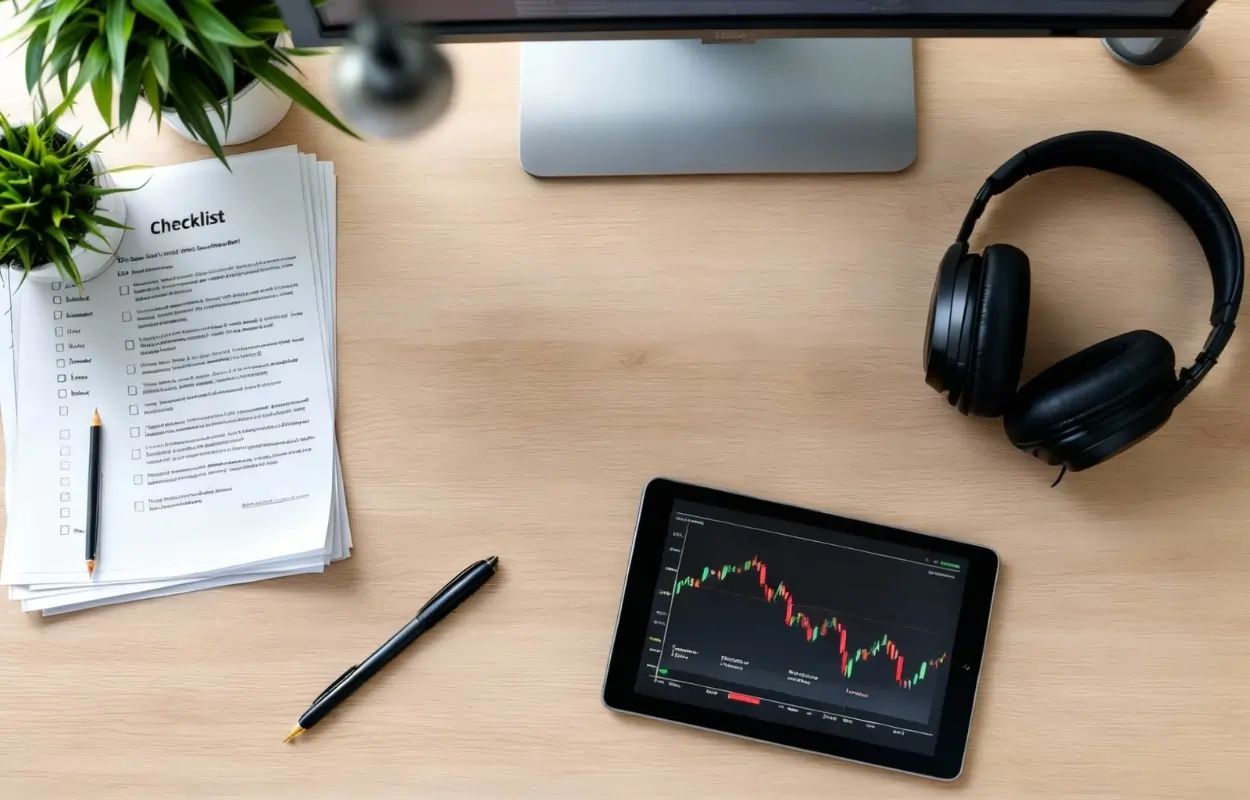
    A routine is most effective when it is a physical, tangible process. Traders are encouraged to print out their pre-trade checklist and have it on their desk. The act of physically ticking off each item before placing an order creates a powerful psychological barrier to impulsive behavior. It forces a pause and a moment of objective reflection.

    Over time, this habit can be the difference between disciplined execution and impulsive trading. Some traders even use a two-person rule in their early careers, requiring them to explain the rationale for a trade to a colleague or mentor, using the checklist as a script, before they are allowed to execute it.​

    The long-term benefits of a disciplined start

    Adhering to a pre-trade routine does more than reduce errors.. A trader who follows a structured process knows that their actions are repeatable and based on tested criteria. This helps manage the emotional impact of losses, framing them as part of a long-term system rather than personal failures.

    Moreover, a standardized routine preserves mental energy. By automating preparatory steps, the trader can focus more effectively on real-time analysis and trade management.

    A pilot does not resent the pre-flight checklist, but they see it as the foundation of a safe flight. A surgeon does not skip the pre-operative briefing: they see it as essential for a successful outcome. A professional trader must view their pre-trade routine in the same light. It is not a burden. It supports consistent, professional-level execution in an environment defined by uncertainty..

    A Final Word on Risk

    Even the most disciplined preparation cannot remove uncertainty from trading. A pre-trade routine strengthens structure and decision-making, but it does not guarantee outcomes. Markets can behave unpredictably, and losses are an inherent part of participation. The objective of such routines is not to eliminate risk, but to manage it through consistency and process. Over time, this disciplined approach can help preserve capital, maintain emotional balance, and support long-term trading sustainability.

    Trading involves substantial risk. This content is for informational and educational purposes only and does not constitute investment advice.

  • Stop-Losses: Your Contract with the Market

    Stop-Losses: Your Contract with the Market

    A legendary commodities trader was once asked the single most important lesson from his decades-long career. He did not mention a secret indicator or a complex forecasting model. He pointed to a line he had drawn on a chart before entering a trade. He said, “That line is where I am wrong.

    Before I even think about how much I can make, I define the exact point where my idea is invalid. If the price touches it, I am out.

    No questions, no hesitation. The market does not care about my opinion, and that line is my contract with reality.” This simple act, this pre-defined acceptance of being wrong, forms the foundation of disciplined trading. A stop-loss is not merely a tool. It represents an agreement a trader makes with the market to preserve capital and maintain consistency.

    What is a stop-loss?

    A stop-loss is an order placed with a broker to close a position when it reaches a specific price, limiting the loss on that trade. For a long position (a buy), the stop-loss is set at a price below the entry.

    For a short position (a sell), it is set at a price above the entry. It is an automated risk management mechanism designed to help ensure that a single losing position does not cause disproportionate harm to a trading account. It answers the most important question for any trade: “How much am I willing to risk to find out if my analysis is correct?” By defining this amount in advance, a trader removes the emotional burden of making that decision in the heat of the moment.​

    The logic of capital preservation

    The primary job of a trader is not to make money. It is to manage risk. Profit tends to be a byproduct of effective risk management. A stop-loss is the ultimate expression of this principle. It ensures that losses are kept small and mathematically manageable.

    For example, recovering from a 50% drawdown requires a 100% gain just to break even. By limiting each trade’s risk to a small, pre-defined portion of capital (for instance, 1% or 2%), a trader can sustain a longer learning curve and improve the probability of long-term survival.

    Methods for setting a stop-loss

    The placement of a stop-loss is a skill. It should not be arbitrary. The location of the stop must be logical, based on either the market’s structure or a defined risk management rule. Placing it correctly balances the need to give a trade enough room to work against the need to cut losses efficiently.

    Chart-Based Stop-Loss: This method uses technical analysis to identify a logical invalidation point for the trade idea. A trader places the stop at a level where the market structure would prove the initial thesis wrong.​

    • For a long trade, a stop could be placed just below a recent swing low or a key support level.
    • For a short trade, it could be placed just above a recent swing high or a key resistance level.​

    This is often considered the most professional approach, as the stop is tied to the market’s own behavior.

    Percentage-Based Stop-Loss: This method involves setting the stop at a price that corresponds to a fixed percentage of the trader’s capital. A common rule is to risk no more than 1% or 2% of the total account balance on a single trade.

    For example, on a $20,000 account, a 1% risk is $200. The position size is then calculated based on the stop distance to ensure the maximum loss is $200. This enforces consistency in money management.


    Volatility-Based Stop-Loss: Markets are not static; their volatility changes. A volatility-based stop adjusts to current market conditions. Using an indicator like the Average True Range (ATR), a trader can set a stop that is a multiple of the recent price volatility. In highly volatile periods, the stop will be wider to avoid being triggered by normal price swings. In quiet periods, the stop will be tighter. This adapts the risk to the market’s current character.​


    Trailing Stop-Loss: A trailing stop automatically adjusts as a trade moves in the trader’s favor. For a long position, as the price moves up, the stop-loss also moves up, but it never moves down. This can help lock in gains while allowing participation in further potential trend continuation.

    The contract must be honored

    A stop-loss only serves its purpose if it is honored. One of the most common and destructive mistakes a trader can make is moving a stop-loss to accommodate a losing trade. This violates the pre-made contract. It is an emotional decision, born of hope that the market will turn around. Maintaining discipline means treating the pre-defined stop as a firm boundary set under objective conditions.

    Once a trade is open, the trader’s role is to execute the plan, not rewrite it mid-course. Over time, this discipline builds consistency and confidence.

    Potential limitations

    While stop-losses are essential elements of prudent trading, they are not perfect. Traders must be aware of its limitations. In extremely volatile or illiquid markets, “slippage” can occur. For example, during a sharp gap in price, a stop-loss might trigger at the next available price, which could be less favorable.

    However, even with such limitations, most professional traders consider stop-losses a core defense against uncontrolled downside exposure. They are tools of structure and survival — mechanisms to ensure that capital is preserved for future opportunities.

    A Final Word on Risk

    No strategy or order type can eliminate the inherent risks of trading. Market conditions can change suddenly and unpredictably, and losses are an unavoidable part of participation. The purpose of a stop-loss is not to guarantee success, but to manage uncertainty in a structured and disciplined way.

    Trading without a stop-loss is a decision to bear unlimited risk. Trading with one is a decision to respect probability, structure, and sustainability. In the long run, it is this respect — not prediction — that separates consistent traders from hopeful speculators.

    Trading involves substantial risk. This content is for informational and educational purposes only and does not constitute investment advice.