
Category: Marketing Intelligence

  • Information Diet: How to Filter Market Noise and Avoid Hype

    Information Diet: How to Filter Market Noise and Avoid Hype

    An old story circulates on trading desks about a bond trader known for his distinct approach, who worked in the corner of a bustling floor. While his colleagues surrounded themselves with walls of monitors, streaming news feeds, and squawking intercoms, his desk was spartan.

    He had one screen showing his charts and a telephone. He never watched financial television. He read the newspaper, but only the day-old international edition.

    His rationale was simple: by the time information reached him, the market’s emotional, knee-jerk reaction was already over. He was only interested in the second-order effects, the real trend that emerged after the panic and excitement faded. He had, in effect, put himself on a strict information diet.

    In an era where traders have access to infinite data, the ability to filter is more important than the ability to find. Long-term performance depends not by what a trader consumes, but by what they choose to ignore.

    Defining noise and hype

    The modern market is a cacophony. Differentiating signal from noise is a primary task for any serious participant. Market noise consists of random price movements and data points that distort the underlying trend. This includes minor, insignificant price ticks and short-term volatility spikes that have no bearing on the market’s true direction.

    Noise creates false signals, encourages premature exits, and erodes confidence.​

    Hype is a different but related phenomenon. It is noise amplified by emotion. Hype is a narrative, often spread through social media or sensationalist news headlines, that creates a powerful sense of urgency. It appeals to  the fear of missing out (FOMO) and compels traders to act on incomplete information.

    Claims such as a stock being “set to skyrocket” or a currency “about to collapse” reflect sentiment rather than structured analysis. Engaging critically with such content helps maintain objectivity and avoid emotionally driven decisions.

    Technical filters for market noise

    Filtering noise is a technical problem that can be addressed with specific tools and methods. The goal is to smooth out price action to get a clearer picture of the dominant trend.​

    Multi-Timeframe Analysis: A commonl noise-reduction technique.

    A trader looks at the same instrument across different timeframes to establish context. For example, before looking for an entry on a 15-minute chart, a trader should analyze the daily and 4-hour charts. If the daily chart shows a clear downtrend, a bullish pattern on the 15-minute chart is likely just noise, a minor upward correction within a larger decline. This perspective may help prevent a trader from fighting the primary trend based on short-term fluctuations.​


    Noise-Reducing Chart Types: Traditional candlestick charts display every price movement within a set time period, which can make patterns appear cluttered. Alternative chart types can filter this.

    • Heikin-Ashi Charts: These charts average price data to create a smoother appearance, making trends easier to identify. They modify the open-high-low-close values to reduce the visual effect of minor volatility.
    • Renko Charts: Renko charts ignore time completely and focus only on price movement of a certain magnitude. A new “brick” is only drawn when the price moves a predetermined amount, clarifying trends and minimizing visual noise from small sideways movements.

    Trend-Following Indicators: Certain indicators are designed not to predict reversals but to confirm the existence and strength of a trend. The Average Directional Index (ADX) is a classic example. An ADX reading above 25 signals a strong trend, either up or down.

    A trader can use this as a filter, deciding to only take trades when the ADX confirms a trending market is in place, thus avoiding whipsaws in range-bound, noisy conditions.

    Procedural defenses against hype

    Avoiding hype is less about technical tools and more about building a disciplined process. It is a defense against emotionally charged narratives and impulsive decision-making.​

    Defense TacticImplementation
    Structured Research ProcessBefore any trade, a trader may consider reviewing multiple independent and reputable sources. If a story appears on a social media feed, it may be prudent to cross-reference it  it with an established news service or relevant fundamental data before forming an opinion.
    The 24-Hour RuleWhen a story generates strong excitement or alarm, introducing a voluntary, 24-hour waiting period before acting ​. This “cooling off” period allows the initial emotional impulse to subside and creates space for objective analysis.
    Source CurationEstablishing a defined set of reliable information sources can support consistency and reduce noise.s. Examples may include central bank websites, official statistics agencies, and a few high-quality, data-driven news outlets. Commentary from unverified online sources should be treated with caution.
    Know the MotiveIt can be helpful to consider the potential motivations behind any published view.An analyst at a large bank may have a different motive than an anonymous account on Twitter. Understanding potential biases is a key part of the filtering process.

    Building an effective information diet

    An information diet, like a nutritional one, is about conscious choices for long-term health. It is not about restricting information entirely but about managing what and when to consume.

    1. Schedule Information Intake: Continuous exposure to market news can contribute to decision fatigue. It may create decision fatigue. Instead, a trader may considerschedule specific blocks of time, perhaps 30 minutes before the London open and 30 minutes before the New York open, for market research. Outside of these windows, the news is turned off. This may help reduce stress and the temptation to react to every headline.
    2. Focus on “Slow” Information: Prioritize information that has a longer shelf life. For example a central bank’s quarterly inflation report typically provides deeper insight than a politician’s off-the-cuff remark. An analysis of long-term economic cycles is more valuable than a “hot tip” from a TV pundit. This shifts the focus from guessing the next few minutes to understanding the next few months.
    3. Optimize the Physical State: Mental clarity plays an important role in analytical decision-making. Balanced nutrition, adequate rest, and physical activity are associated with improved focus and concentration. Studies show that even mild dehydration can impair concentration and memory. Foods that provide sustained energy, like whole grains and proteins, are preferable to sugary snacks that cause energy spikes and crashes. Physical well-being creates the mental clarity required to distinguish a genuine opportunity from a tempting distraction.​

    A trader who actively designs and follows an information diet stops being a passive consumer of market chatter. They become an active filter, allowing only the highest-quality inputs to influence their decisions. This discipline protects not just their capital, but also their most valuable asset: their mental energy.

    A Final Word on Risk

    All trading involves uncertainty. No system, analysis, or information filter can eliminate risk entirely. Markets are influenced by countless variables — economic, geopolitical, and psychological — many of which cannot be anticipated. Understanding that losses are a natural part of participation helps maintain perspective and emotional balance. Ultimately, consistent success in trading is less about prediction and more about preparation — aligning one’s mindset, methods, and risk tolerance with the inherently uncertain nature of the market.

    Trading involves substantial risk. This content is for informational and educational purposes only and does not constitute investment advice.

  • Tools of the Trade: A Comparison of Day Trading and Swing Trading Setups

    Tools of the Trade: A Comparison of Day Trading and Swing Trading Setups

    A trader’s effectiveness is a direct function of their tools. Just as a master carpenter would not use a sledgehammer to craft a delicate piece of furniture, a trader must select a setup that aligns with their chosen trading style.

    The high-velocity world of day trading and the more patient rhythm of swing trading demand distinctly different arsenals. While both disciplines share a common goal of profitability, the hardware, software, and analytical tools they employ are tailored to their unique time horizons and strategic needs.

    The Day Trader’s Cockpit: Built for Speed and Data-Intensive Operations

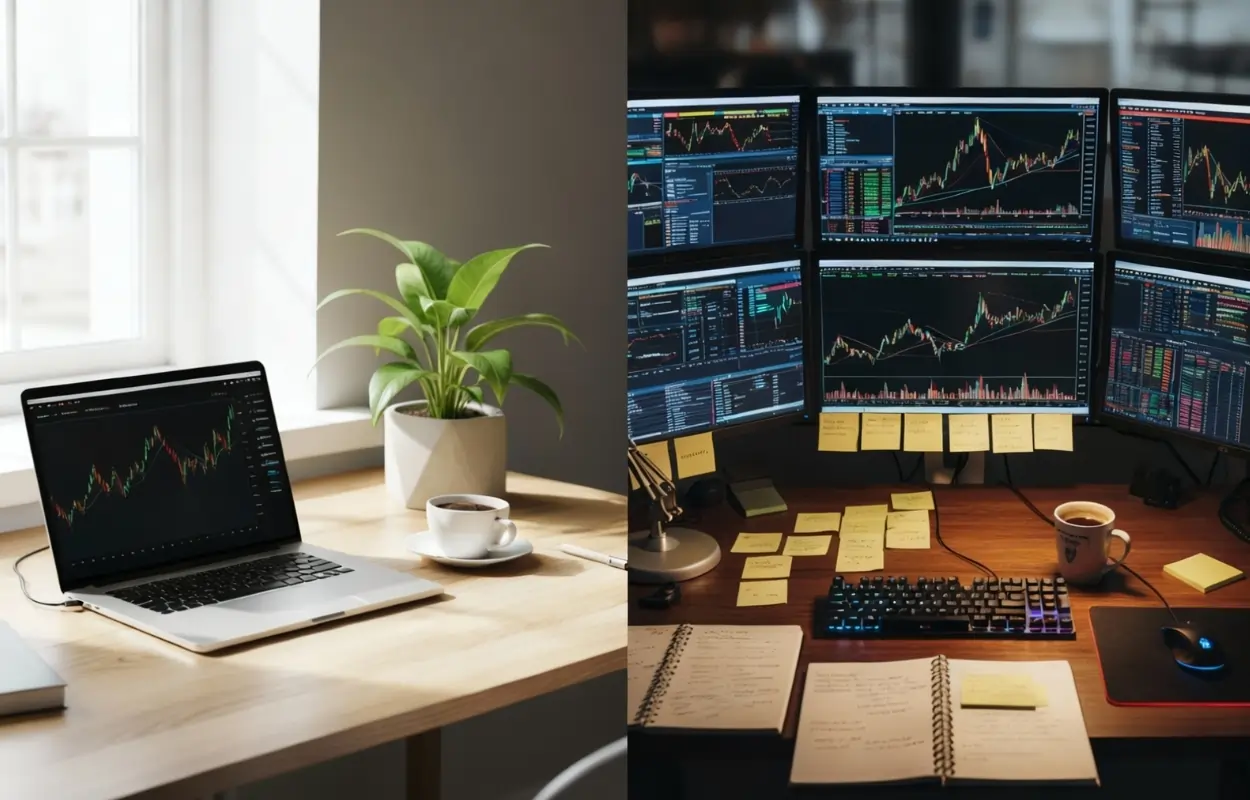
    The day trader’s environment is engineered for speed, reliability, and the capacity to process a massive amount of real-time information. The core of this setup is a high-performance computer. Because day trading involves making split-second decisions based on rapid price fluctuations, there is no room for technical lag or system failure.

    A powerful central processing unit (CPU), such as a modern Intel Core i7 or AMD Ryzen 7, is essential for instantly executing orders and running complex analytical software. At least 16GB of RAM is considered the minimum to handle the demands of multiple applications running at once.

    A multi-monitor display is not a luxury but a necessity. A typical day trading station will feature at least three screens, and often more. This allows a trader to view several critical pieces of information simultaneously:

    • Charting software on a primary monitor, displaying price action across multiple timeframes.
    • A Level 2 data feed on a second screen, showing real-time bid and ask orders.
    • Financial news tickers and an economic calendar on a third, to stay abreast of market-moving events.

    The choice of trading platform is equally critical. Day traders require a platform that offers Direct Market Access (DMA) for the fastest possible order execution. Features like one-click trading, customizable hotkeys, and advanced charting with a wide array of technical indicators are standard. The software must be robust and stable, as a platform crash during a live trade can be catastrophic.

    Finally, a fast and reliable internet connection is non-negotiable. A hardwired, fiber-optic connection is strongly preferred over Wi-Fi to minimize latency, the small delay between when an order is placed and when it is executed.

    An uninterruptible power supply (UPS) is also a wise investment, providing a battery backup to prevent a sudden power outage from disrupting a trading session.

    The Swing Trader’s Workshop: Flexibility and Analytical Depth

    The swing trader’s setup, while still professional, is generally less demanding in terms of raw hardware specifications. Because swing trading decisions are made over hours and days, the need for millisecond-level execution speed is less acute. A modern laptop or a well-configured desktop computer with a reliable processor and sufficient RAM (8GB is often adequate, though 16GB is better) is typically sufficient.

    While a multi-monitor setup is still beneficial for analyzing charts and news, it is not as mission-critical as it is for a day trader. A swing trader might use a primary monitor for in-depth chart analysis and a secondary screen or a laptop to track a watchlist and read research reports.

    The emphasis is less on processing a deluge of real-time data and more on conducting thorough analysis.

    The choice of software for a swing trader is centered on analytical power and ease of use. Platforms like TradingView or MetaTrader 4 are popular choices, offering powerful charting packages, a vast library of technical indicators, and tools for backtesting strategies. Since trades are held for longer periods, mobile trading apps also play a more significant role, allowing a trader to monitor positions and make adjustments while away from their primary workstation.

    The following table provides a clear comparison of the two setups:

    FeatureDay Trading SetupSwing Trading Setup
    ComputerHigh-end desktop with top-tier CPU and at least 16GB RAM. Modern desktop or laptop with a solid processor and 8-16GB RAM.
    MonitorsThree or more high-resolution monitors are standard. One or two monitors are often sufficient. 
    InternetHigh-speed, low-latency, hardwired connection is essential.A stable broadband connection is adequate.
    SoftwareDirect Market Access (DMA) platform with advanced order types and Level 2 data. Charting-focused platform with strong analytical and backtesting tools. 
    Data FeedsReal-time, tick-by-tick data is required.End-of-day or slightly delayed data may be acceptable for some strategies.
    MobilityPrimarily a stationary setup.Can be more mobile, with a greater reliance on laptops and tablets. 

    The Common Ground: A Foundation of Quality

    Despite their differences, both day trading and swing trading setups are built on a common foundation of quality and reliability. In both disciplines, a trader’s tools must be dependable. A system crash, a data feed interruption, or a slow internet connection can be costly for any style of trader.

    Furthermore, both types of traders benefit from clean, ergonomic workspaces. A comfortable chair, a keyboard and mouse that fit the hand well, and proper monitor positioning can reduce fatigue and improve focus during long hours of market analysis.

    Ultimately, the choice of a trading setup is a personal one, dictated by the specific needs of the individual and their chosen strategy. The day trader builds a cockpit for high-speed maneuvering through volatile markets. The swing trader assembles a workshop for the patient and detailed construction of a trade. In both cases, the tools are not an afterthought. They are an integral part of the profession.

  • A Day in the Life of a Day Trader: A High-Speed Profession

    A Day in the Life of a Day Trader: A High-Speed Profession

    The city is still dark. Streetlights cast a sterile glow on empty streets while the vast majority of the population sleeps. But in a quiet room, lit only by the cold, blue light of multiple monitors, a day is already in full swing.

    This is the world of the day trader, a profession defined not by a 9-to-5 schedule but by the relentless ticking of the global markets. It is a pursuit of infinitesimal gains, repeated hundreds of times, where fortunes are sought in the flicker of a price chart.

    The Dawn Patrol: Pre-Market Analysis

    Long before the opening bell of the local stock exchange, the day trader’s work begins. This pre-market period, typically starting around 4:00 AM, is a critical phase of intelligence gathering and strategy formulation. The first order of business is to absorb what happened while the Western hemisphere was dark. Markets in Asia and Europe have already been active for hours, and their movements provide context for the day ahead.

    A trader’s morning routine involves a systematic review of several key information sources.

    • Overnight market performance in major indices like the Nikkei 225, Hang Seng, and DAX 40.
    • Futures markets, which offer an early indication of market sentiment.
    • A thorough scan of financial news wires for any corporate announcements, geopolitical events, or economic data releases that occurred overnight.
    • Close attention to the economic calendar for high-impact events scheduled for the day, such as inflation reports, employment figures, or central bank interest rate decisions.

    With this information, the trader builds a specific watchlist for the day. This is a curated list of assets, perhaps a few currency pairs, stocks, or commodities, that exhibit potential for significant price movement.

    For each asset on the list, a detailed trading plan is developed. This plan outlines precise price levels for entering a trade, a target for taking profits, and a stop-loss order to cap potential losses. This preparation is not a suggestion. It is a foundational element of a disciplined approach.

    The First Ninety Minutes: Navigating Opening Volatility

    The market opening is a period of intense activity. The first 90 minutes often see the highest trading volume and the most significant price swings of the day. This is where the pre-market preparation is put to the test. A day trader does not react impulsively to the initial chaos. Instead, they execute the plan they have already built.

    When a price hits a predetermined entry point for an asset on the watchlist, a trade is executed without hesitation. The process is swift and mechanical. The trader’s focus shifts immediately to managing the open position. They monitor price action across multiple timeframes, from one-minute charts to fifteen-minute charts, looking for confirmation of their trade thesis or signs that it is failing.

    This phase is a high-speed exercise in pattern recognition and risk management. A trader might manage several open positions at once, each with its own profit target and stop-loss. The goal is to capture small, quick profits.

    A successful trade might last only a few minutes. If a trade moves against them and hits the stop-loss level, it is closed immediately to prevent a small loss from becoming a large one. Emotion is a liability. Discipline is the operating system.

    The Mid-Day Assessment: A Period of Recalibration

    After the initial flurry of activity, the market often enters a quieter period. The volume subsides, and price movements become less pronounced. For the day trader, this mid-day lull is not a time for rest. It is a time for strategic reassessment.

    The first task is to review the morning’s performance. A trader will analyze the trades taken, both winning and losing. They evaluate the effectiveness of their initial plan and identify any execution errors. This analysis informs adjustments for the remainder of the session. Market conditions change, and a successful trader adapts.

    During this period, some traders will scan for new opportunities that align with the evolving market environment. Certain patterns, like mid-day trend reversals, are common during these hours.

    A trader might identify a new setup and execute a trade, but with caution, as lower liquidity means price movements are less reliable. For many, this time is best spent observing and waiting for high-probability setups to emerge as the market heads toward its final hours.

    The Closing Bell: Locking in Profits and Losses

    As the trading day nears its end, activity often picks up again. Traders who are holding positions will look to close them out, creating another surge in volume. For a day trader, the most important rule is to finish the day “flat,” meaning they hold no open positions overnight. Holding a position overnight exposes a trader to risks from events that occur when the market is closed.

    The final hour is about disciplined position management. It is not a time to enter new, speculative trades. The focus is on exiting existing positions at the best possible prices. If a trade is profitable, the trader will close it to secure the gain.

    If a trade is at a loss, it is closed to adhere to the core principle of capital preservation. The day’s final profit or loss is tallied only after the last position is closed. The closing bell marks the end of the trading battle, but not the end of the workday.

    The Post-Mortem: Review and Preparation

    With the market closed, the final and perhaps most important phase of the day begins: the post-market review. This is a detailed audit of the day’s trading activities. Every single trade is logged into a journal.

    Each journal entry typically contains:

    • The asset traded.
    • The entry and exit price.
    • The reason for taking the trade.
    • The outcome of the trade (profit or loss).
    • Notes on what was done well and what could be improved.

    This process transforms raw experience into a database for performance improvement. By analyzing this data over time, a trader can identify recurring mistakes, refine successful strategies, and gain a deeper understanding of their own psychological tendencies.

    This self-assessment is what separates professional traders from amateurs. The work concludes with a preliminary scan of the news and charts to begin forming a thesis for the next day. The cycle repeats. The pursuit of an edge is constant. The day trader’s day ends, as it began, in quiet analysis.

  • Reading the Market: Applying Fibonacci in Trending vs. Ranging Markets

    Reading the Market: Applying Fibonacci in Trending vs. Ranging Markets

    The trading chart is a battlefield document. It records the skirmishes between buyers and sellers, minute by minute, day by day. To the untrained eye, it is a mess of jagged lines and chaotic impulses. A seasoned trader sees something else. They see patterns.

    They see structure. Most importantly, they see context. Before any indicator is applied, before any button is clicked, the successful trader asks a fundamental question: Is the market moving with purpose, or is it trapped in a fight with itself?

    This is the distinction between a trending market and a ranging one. It is the single most important piece of information on the screen, and it dictates the correct application of any tool, especially the sequence of ratios known as Fibonacci.

    The Anatomy of a Trend

    A market in a trend has direction. It makes progress. In an uptrend, this progress is marked by a series of higher highs and higher lows. Each new peak surpasses the last, and each valley finds its bottom at a higher level than the one before.

    This is the footprint of consistent buying pressure. Sellers attempt to push the price down, but buyers consistently overwhelm them at progressively higher prices. A downtrend is the mirror image: a sequence of lower lows and lower highs.

    Sellers are in command. Buyers attempt to rally, but their efforts fail, and the price falls to new depths.

    This structure of impulse and correction is where the Fibonacci retracement tool finds its primary function. The logic is rooted in market behavior. A strong move in the direction of the trend is called an impulse wave. Following this burst of activity, the market often takes a breath. This is the retracement or pullback.

    It is a period of profit-taking or a counter-move from the opposing side. The trend has not ended. It is simply pausing. The Fibonacci retracement tool helps projects where this pause might find support or resistance before the original trend resumes.

    The trader’s goal is to enter the market at the end of the retracement, positioning for the next impulse wave.

    Fibonacci’s Role in a Trending Environment

    Applying the tool requires precision. In a clear uptrend, the trader identifies a significant swing low and a subsequent swing high. The Fibonacci tool is drawn from the low point to the high point. This action overlays a series of horizontal lines on the chart at key percentage levels of the total move.

    The most watched levels are 38.2%, 50%, and 61.8%. These are not arbitrary numbers. They are derived from a mathematical sequence discovered centuries ago, but their relevance in financial markets comes from collective human psychology and algorithmic execution.

    Each level tells a story about the strength of the trend. A shallow pullback that finds support at the 38.2% level signals significant strength. The market is eager to continue its upward journey. Buyers stepped in quickly, unwilling to let the price drop further. A retracement to the 50% level indicates a more balanced pause. It is a common and healthy pullback.

    A deep retracement to the 61.8% level, often called the golden ratio, represents a more serious test of the trend. It shows sellers were able to force a substantial correction.

    A bounce from this level, however, can provide a high-conviction entry point, as it suggests the trend has withstood a significant challenge and is ready to resume. For a downtrend, the application is inverted. The tool is drawn from a swing high down to a swing low, with the levels now acting as potential resistance points for a rally.

    The Sideways Shuffle: Markets in Consolidation

    Not all markets trend. Many spend considerable time in consolidation, known as a ranging market. Here, the price is contained between a clear level of support below and resistance above. Buyers and sellers are in a state of equilibrium.

    Buyers defend the support level, and sellers defend the resistance level. The price action appears to move sideways, bouncing between these two boundaries. There are no higher highs and higher lows. There are no lower lows and lower highs. There is only a struggle for control with no clear victor.

    This environment is notoriously difficult for trend-following systems. A strategy designed to buy pullbacks in an uptrend will fail because there is no uptrend to resume. Entries are taken, only to see the price reverse at the top of the range.

    Likewise, a strategy to sell rallies in a downtrend gets stopped out as the price bounces off the bottom of the range.

    Applying Fibonacci retracements in the standard way during a range is a common error. Drawing the tool from a low to a high within the range will provide levels, but these levels lack the critical context of a directional trend. They become noise, not signals.

    Applying Fibonacci in a Ranging Market

    An unconventional analyst does not discard a tool simply because the textbook context is absent. They adapt. While standard retracement application is ill-advised in a range, Fibonacci can be repurposed. One method involves using the ratios to analyze the internal structure of the range itself.

    By drawing the Fibonacci tool from the high of the range to the low of the range, a trader can identify a 50% line. This midpoint of the range often acts as a significant pivot. Price action above the 50% line shows short-term strength, while action below it shows short-term weakness. Trades can be initiated at the boundaries of the range with a target toward this midpoint.

    Another advanced application involves using Fibonacci extensions, a topic for another day, to project breakout targets. When a price is contained in a range, it will eventually break out. By measuring the height of the range and applying Fibonacci projection ratios, a trader can set logical price targets for where the breakout move might travel.

    This shifts the tool’s purpose from identifying entries within a trend to setting profit targets after a period of consolidation has ended. This requires patience. The trader is not acting inside the range but is waiting for the range to break.

    Common Pitfalls and Misinterpretations

    The effectiveness of any tool is limited by the skill of its operator. With Fibonacci, several common errors lead to poor results. The first is improper placement of the swing points. The selection of the swing low and swing high that define the impulse move is subjective. Choosing insignificant minor swings instead of major, structural ones will produce unreliable levels.

    The chosen swing points must represent a clear, committed move by the market.A second major pitfall is using the Fibonacci levels in isolation. No single indicator is a complete trading system.

    A Fibonacci level is an area of potential support or resistance. It is not a guarantee. A prudent trader looks for confluence. They wait for other signals to align with the Fibonacci level. This could be a candlestick reversal pattern, a moving average acting as support, or an oversold reading on an oscillator. When multiple, independent signals point to the same conclusion, the probability of a successful trade increases substantially.

    The Fibonacci level becomes one piece of evidence, not the entire case. Finally, the most fundamental error is ignoring the market context. A trader must first classify the market as trending or ranging. Applying a trend-based Fibonacci strategy in a ranging market is a flawed premise from the start. Market structure analysis always comes first.

    The tool is secondary to understanding the environment. The numbers on the chart mean nothing without the story behind them.

  • Finding Trading Opportunities in Developing Economies

    Finding Trading Opportunities in Developing Economies

    Investors often look toward emerging markets for growth. These are not frontier economies. They are not fully developed economies either. They are nations in a state of rapid economic transformation. Think of countries like Brazil, India, Mexico, and Indonesia.

    These nations show significant industrialization as they are integrating into the global financial system. Their defining feature is fast-paced growth that often outpaces established economies in North America or Western Europe.

    This progress is not a straight line. These economies possess specific characteristics. They typically feature a growing middle class. This population segment increases demand for goods and services. They also undertake continuous market reforms. Governments work to open their economies to foreign investment. They seek to create more stable financial systems

    This transition is complex. It presents a dual-sided scenario for traders. There is a potential for high rewards. There is also the presence of significant risk. A successful approach requires a deep understanding of the forces at play.

    You need to look beyond the headlines. You must analyze the fundamental economic drivers.

    The Allure of Growth

    The primary appeal of emerging markets is their growth potential. Several factors create this environment. These factors present unique opportunities for informed traders. Understanding them is the first step in building a sound strategy.

    First, consider interest rate differentials. Central banks in emerging economies often set higher interest rates compared to developed nations. They do this to combat inflation. They also do it to attract foreign investment. For forex traders, this creates a potential for carry trades.

    You borrow a currency with a low interest rate. You then buy a currency with a higher interest rate. The goal is to profit from the difference. This strategy depends on currency stability. Sharp devaluations wipe out gains from the interest rate spread.

    Second, demographics offer a compelling story. Many emerging nations have young, growing populations. This is the “demographic dividend.” A large, youthful workforce drives production and also forms a massive consumer base.

    This internal engine fuels economic expansion for years. It creates sustained demand for housing, transportation, and consumer goods. This contrasts sharply with aging populations in many developed countries. There, a shrinking workforce presents long-term economic challenges.

    Third, technology acts as an accelerator. Many emerging markets are leapfrogging older technologies. They adopt the latest innovations directly. Consumers in parts of Africa and Asia skipped landlines. They went straight to mobile phones. They skipped credit cards and went to digital payment systems. 

    This rapid adoption speeds up economic efficiency. It creates new industries. It also integrates millions of people into the formal economy for the first time. This technological jump shortens the development cycle. It creates investment opportunities in sectors like fintech and telecommunications.

    Navigating Inherent Risks

    The potential for growth in emerging markets comes with matching risks. These are not markets for the faint of heart. A clear-eyed assessment of the dangers is essential. Ignoring these factors exposes your capital to severe volatility.

    Political instability is a constant factor. Government policies change quickly. Elections produce unexpected outcomes. Social unrest creates economic paralysis. These events directly impact market sentiment and currency values. A new government might nationalize an industry. A trade dispute might erupt. These actions send shockwaves through the financial markets. Capital flees to perceived safe havens. This causes the local currency to weaken. Your strategy must account for this political risk.

    Currency volatility is another major concern. The currencies of emerging economies are often less liquid than major pairs like EUR/USD. They are also heavily influenced by commodity prices. Many emerging nations are major exporters of oil, copper, or agricultural products. A drop in the price of these commodities reduces export revenues. This puts downward pressure on the currency. These currencies are also sensitive to shifts in global investor sentiment. When global risk aversion rises, investors sell emerging market assets. This herd behavior leads to sharp, sudden devaluations.

    Debt is a third critical risk. Many emerging market governments and corporations borrow in foreign currencies, mainly the U.S. dollar. This creates a dangerous vulnerability. If the local currency weakens against the dollar, the real cost of servicing that debt increases. A country might earn its revenue in pesos or rand. It must repay its debt in dollars. A weaker local currency means more local currency is needed to buy the dollars for repayment. This situation can lead to a debt crisis. It is a risk that requires constant monitoring.

    Central Banks Dictate Flow

    Central banks are the most important actors in forex markets. Their decisions create trends that move currencies. This is especially true in emerging economies. Understanding their mandate and their actions is critical for fundamental analysis.

    Central banks in emerging markets have a dual mandate. They must control inflation. They must also maintain currency stability. These two goals are often in conflict. To fight inflation, a central bank raises interest rates. Higher rates make borrowing more expensive. This slows down the economy. Higher rates also attract foreign capital. This strengthens the currency. A stronger currency helps to lower the cost of imported goods, further reducing inflation.

    Conversely, if an economy is weak, the central bank might lower interest rates to encourage growth. Lower rates deter foreign investment. This can weaken the currency. A weaker currency makes exports cheaper and more competitive. It also makes imports more expensive, which can fuel inflation. The central bank must constantly balance these competing pressures. Their statements and actions provide clues to future policy.

    The actions of central banks in developed nations, especially the U.S. Federal Reserve, have a massive impact on emerging markets. When the Fed raises interest rates, it makes holding U.S. dollars more attractive. Capital flows out of riskier emerging markets and into the United States. 

    This “capital flight” weakens emerging market currencies. When the Fed lowers rates, the opposite happens. Investors seek higher yields elsewhere. Capital flows into emerging markets, strengthening their currencies. Your analysis of an emerging market currency is incomplete without a clear view of Fed policy.

    A Strategic Outlook

    Trading emerging market currencies requires a different approach than trading the majors. The markets are driven by different factors. The volatility is higher. The need for sound fundamental analysis is greater. You must connect the dots between economic data, central bank policy, and political events.

    Your strategy should begin with a top-down approach. First, assess the global macroeconomic environment. Is the U.S. Federal Reserve raising or lowering rates? Is global investor sentiment risk-on or risk-off?

    This global picture sets the stage. Second, analyze the specific country. What is its political situation? What is its debt level? What are its key exports, and what are the price trends for those commodities?

    Finally, look at the actions of the local central bank. Is it fighting inflation or promoting growth? Its policy decisions will be a primary driver of the currency’s value. By building this complete picture, you move beyond simple chart patterns. You trade based on the fundamental economic realities of a nation.

    This analytical depth is what separates a speculative bet from a well-reasoned trade. It requires patience. It requires discipline. The opportunities in emerging markets are real. The risks are just as real. Success depends on your ability to see both sides clearly.

  • Signal vs. Noise: Which Economic Indicator Matters Most?

    Signal vs. Noise: Which Economic Indicator Matters Most?

    Traders constantly ask one question. Which economic indicator gives the most reliable signal? They want a single, definitive metric. A number that points to clear profit or loss. This search is understandable. The financial markets are a storm of data. A single lighthouse would make navigating them simpler.

    The truth is more complex. No single indicator is a magic bullet. A solitary data point is just noise. Its value becomes apparent when placed in context. Reliability does not come from one indicator. It comes from the convergence of several. It’s about connecting the dots between economic performance, inflation, and policy. 

    This is how you build a high-level fundamental analysis. This is how you move from reacting to headlines to anticipating market movements. This article provides a framework for that process. It examines the major indicators. It shows how they fit together to create a clearer picture of the market.

    Gross Domestic Product: The Economic Report Card

    Gross Domestic Product (GDP) is the broadest measure of a country’s economic health. It represents the total market value of all final goods and services produced in a specific time period. Think of it as the economy’s annual performance review. A rising GDP suggests a growing, healthy economy. A falling GDP signals contraction.

    For currency traders, GDP is a foundational piece of information. A strong GDP report typically strengthens a nation’s currency. It signals a robust economy that attracts investment. Foreign capital flows into a country with strong growth prospects. This increases demand for its currency. For example, if the United States reports a higher than expected GDP growth, demand for the U.S. dollar often rises. The USD strengthens against other currencies like the euro or the yen.

    GDP’s strength is also its weakness. It is a lagging indicator. The data reflects the past quarter or year. By the time the official numbers are public, the market conditions may have already shifted. Professional traders often have a good idea of the GDP numbers before the release. They follow more frequent data points to build their forecast. 

    Therefore, the biggest market reaction often occurs when the released number is a surprise. If analysts expected 2% growth and the report shows 3%, the market will react sharply. If the number meets expectations, the reaction is often muted. The information was already priced in. You should view GDP as the foundation of your analysis. It sets the long-term context. It confirms the trend. You then use more timely indicators to understand what is happening right now.

    Inflation Gauges: Reading the Price Temperature

    Inflation is a critical force in the forex market. It measures the rate at which the general level of prices for goods and services is rising. It also reflects a fall in the purchasing power of a currency. Two key reports tell you what you need to know about inflation: the Consumer Price Index (CPI) and the Producer Price Index (PPI).

    CPI measures the average change in prices paid by urban consumers for a basket of consumer goods and services. It is the most widely used measure of inflation. PPI tracks the average change in selling prices received by domestic producers for their output. It is often seen as a leading indicator for CPI. If producers are paying more for materials, they will likely pass those costs on to consumers.

    Central banks watch inflation closely. Most have a target inflation rate, typically around 2%. If inflation moves too far from this target, they will act. This is where the trading signal emerges. Persistently high inflation prompts a central bank to increase interest rates. Higher rates make a currency more attractive to foreign investors seeking higher returns on their capital. This inflow of capital increases demand for the currency, causing it to appreciate. 

    For instance, if the Eurozone’s CPI consistently comes in above the European Central Bank’s target, traders will anticipate that the ECB will tighten its monetary policy. This anticipation alone can strengthen the euro. You must watch inflation data not just for the numbers themselves. You watch it to predict the actions of central banks.

    Central Banks and Interest Rates: The Market’s Conductor

    If economic indicators are the orchestra, the central bank is the conductor. While GDP and inflation are vital, the decisions made by central banks are the most direct drivers of currency value. Institutions like the U.S. Federal Reserve, the European Central Bank, and the Bank of England hold immense power. Their primary tool is the overnight interest rate. This is the rate at which banks lend to each other. It influences all other interest rates in the economy.

    The logic is straightforward. When a central bank raises its benchmark interest rate, holding assets in that country’s currency becomes more profitable. Global investment funds will shift capital to take advantage of the higher yield.

    This movement of money, known as “hot money,” increases demand for the currency and pushes its value up. Conversely, when a central bank cuts rates, the currency becomes less attractive. Capital flows out, and the currency weakens.

    The actual rate decision is only part of the story. Forward guidance is just as important. This refers to the statements, press conferences, and meeting minutes released by central banks. In these communications, they signal their future intentions. A central banker might hint that rate hikes are coming if inflation does not cool down. Or they might suggest that the economy is too weak to withstand higher rates. 

    Traders scrutinize every word. They are looking for clues about the path of monetary policy. A change in tone from hawkish (favoring higher rates) to dovish (favoring lower rates) can move the market as much as an actual rate change. Your job is to listen to what central banks are saying. They use data like GDP and CPI to make their decisions. Their actions and words are the most direct signal for traders.

    Employment Data: A Real-Time Economic Pulse

    While GDP is quarterly, employment data is typically released monthly. This frequency gives it immense importance. It offers a more current snapshot of the economy’s health.

    The most watched employment report in the world is the U.S. Non-Farm Payrolls (NFP) report. It is released on the first Friday of every month and is a major market-moving event.

    The NFP report provides three key pieces of data. The first is the number of new jobs created in the non-agricultural sector. The second is the unemployment rate. The third is average hourly earnings, which is a measure of wage inflation. Together, these numbers paint a detailed picture of the labor market.

    A strong NFP report shows that businesses are hiring. This signals a healthy, expanding economy. More people working means more consumer spending, which fuels economic growth. A strong report also suggests potential wage inflation, which can contribute to overall inflation.

    This combination puts pressure on the central bank to consider raising interest rates. As a result, a positive NFP surprise will almost always strengthen the U.S. dollar. 

    A weak report has the opposite effect. It signals economic trouble and reduces the likelihood of rate hikes, weakening the dollar. Because of its timeliness and its direct link to consumer spending and inflation, the NFP report is one of the most powerful short-term indicators for forex traders. It provides a monthly check-up on the health of the world’s largest economy.

    Consumer Health: Confidence and Spending

    Economic activity is ultimately driven by people. If consumers are confident about the future, they spend money. If they are worried, they save. That is why measures of consumer health are valuable leading indicators. They offer a glimpse into future economic trends. Two such indicators are the Consumer Confidence Index (CCI) and Retail Sales reports.

    The CCI is a survey that measures how optimistic consumers are about their financial situation and the overall economy. A high level of confidence suggests that people are more likely to make large purchases in the coming months. This could be a new car, a home, or a vacation.

    This spending drives economic growth. The Retail Sales report provides a more direct measure of that spending. It tracks the total value of sales at retail stores. It is a direct indicator of consumer demand.

    For traders, these indicators provide a look into the future. A strong and rising consumer confidence report, followed by a solid retail sales number, suggests that economic growth will continue. This reinforces the case for a strong currency. It confirms that the economic fundamentals are sound. However, these indicators also have limitations. Confidence is a feeling. It does not always translate into actual spending. 

    A person might report feeling confident but still choose to save their money because of specific personal concerns. For this reason, you should use consumer data in conjunction with other indicators. When confident consumers are actually spending, as confirmed by retail sales, the signal is much stronger.

    Building a Coherent Framework

    No single indicator provides a perfect signal. The key is to synthesize the information from all of them. You need a framework that connects long-term trends with short-term data. This allows you to build a trading thesis based on a convergence of evidence.

    Start with the big picture. Use annual and quarterly GDP data to establish the long-term economic trend of a country. Is the economy in a solid expansion, or is it struggling? This is your baseline.

    Next, focus on inflation. Watch the monthly CPI reports. Is inflation heating up and moving away from the central bank’s target? High inflation in a growing economy is a strong signal for future interest rate hikes.

    Then, turn all your attention to the central bank. Read their statements. Listen to their press conferences. Are they sounding hawkish or dovish? Their language will tell you how they are interpreting the GDP and CPI data. Their forward guidance is your most important clue.

    Finally, use the high-frequency monthly data to test your thesis. Watch the NFP, retail sales, and consumer confidence reports. Do these numbers confirm the broader economic story? For example, if your thesis is that the U.S. economy is strong and the Fed will raise rates, you expect to see strong NFP and retail sales numbers.

    If you get them, your thesis is confirmed. If the numbers are weak, you must question your thesis. The market is telling you something has changed.

    This process transforms you from a reactive trader into a proactive one. You are not just following one number. You are understanding the entire economic story. When multiple indicators all point in the same direction, you have found a reliable signal. It is not a guarantee. It is a high-probability opportunity based on a deep understanding of fundamental forces.