Category: Trading Psychology

  • Mindfulness for Traders: Techniques to Stay Calm Under Pressure

    Mindfulness for Traders: Techniques to Stay Calm Under Pressure

    An elite bomb disposal technician was asked how he stays calm while snipping wires that could trigger an explosion. His answer was not about courage or fearlessness. He said, “I don’t think about the bomb. I don’t think about what happens if I fail. I only think about my breath, the feeling of the tool in my hand, and the precise color of the wire I am about to cut. My world shrinks to only what is right here, right now.” 

    This intense, non-judgmental focus on the present moment is the essence of mindfulness. For traders, while the environment is financial rather than physical, the principle is the same.  The constant pressure, the potential for financial loss, and the flood of information can trigger an explosion of emotional, irrational decisions.

    Mindfulness is a tool that can help traders manage this pressure, cultivating the calm and focus needed for more deliberate, process-driven decisions.

    What is mindfulness in trading?

    Mindfulness in the context of trading is not about sitting in a quiet room for hours. It is the active, moment-to-moment awareness of one’s thoughts, emotions, and physical sensations without getting carried away by them.

    It is the ability to observe the rise of fear after a sudden market drop, to notice the pull of greed during a fast-moving rally, and to acknowledge these feelings without letting them dictate action. A mindful trader can watch the internal drama unfold as if they were a neutral observer. This separation between awareness and action is the key to breaking the cycle of emotional trading.​

    The tactical advantages of a mindful state

    Practicing mindfulness provides concrete, measurable benefits that directly address severa;common challenges in trading..

    Emotional Regulation: Mindfulness training helps traders identify and label emotions rather than react impulsively to them.. It allows a trader to label an emotion, “There is fear,” rather than becoming it, “I am afraid.” This act of observation diminishes the emotion’s power and prevents it from hijacking the decision-making process.​


    Improved Focus and Clarity: The market is a sea of noise. Mindfulness improves concentration, helping a trader to filter out irrelevant information, social media chatter, and their own distracting internal monologue. The focus shifts from random price ticks to the core components of the trading plan.​


    Reduced Impulsive Behavior: Emotional trading is reactive. A mindful trader creates a small gap between a stimulus (e.g., a sudden price spike) and their response. In that gap lies the freedom to choose a deliberate action based on the plan, rather than an impulsive one based on emotion.​


    Effective Stress Management: Mindfulness practices such as controlled breathing can support the body’s relaxation response, helping traders maintain composure during volatile conditions.. This helps a trader maintain a state of relaxed alertness, even during periods of high market volatility.​

    Practical mindfulness techniques for the trading desk

    Mindfulness is a skill built through consistent practice. These techniques can be integrated directly into a trading day.

    1. The Pre-Market Prime: Before the trading session begins, a trader can engage in a 5 to 10-minute mindfulness exercise. This can be a guided meditation using an app or simply focusing on the sensation of breathing. The goal is to start the day from a baseline of calm and centeredness, rather than rushing into the market with a scattered mind.​
    2. The 4-7-8 Breathing Technique: When stress peaks during a volatile trade, this simple breathing exercise can reset the nervous system. A trader can pause, inhale quietly through the nose for a count of four, hold the breath for a count of seven, and then exhale completely through the mouth for a count of eight. Repeating this three or four times can help reduce immediate tension.
    3. The Mindful Body Scan: Stress often manifests as physical tension. Periodically during the day, a trader can conduct a quick body scan. This involves mentally scanning from head to toe, noticing areas of tension, such as a clenched jaw, raised shoulders, or a tight stomach, and consciously releasing them.​
    4. Scheduled “Screen-Off” Breaks: A trader can schedule mandatory 5-minute breaks every hour. During this time, they step away from the screens. Instead of checking a phone, they can practice mindfulness by simply noticing the sights and sounds around them or doing a few simple stretches. This prevents mental fatigue and resets focus.​
    5. The Emotional Journal: A trader can enhance their trading journal by adding a column for their emotional state before, during, and after each trade. Writing down, “Felt anxious and entered the trade early,” provides objective data on how emotions are impacting performance. This self-awareness is the first step toward change.​

    Integrating mindfulness with strategy

    Mindfulness is not a standalone solution, its a complement . A plan provides the “what to do.” Mindfulness provides the clear mental state needed “to do it” with discipline. It helps a trader to follow their rules, even when it is uncomfortable.

    When a trade hits its stop-loss, a mindful trader can observe the feeling of disappointment without judging it as a personal failure. This allows them to learn from the mistake and move on to the next trade with a clear head, treating the loss as a business expense.​

    A mindful approach supports a growth mindset, helping traders evaluate their performance non-judgmentally and refine their process over time. It reinforces the understanding that trading is as much a mental discipline as a technical one.

    A Final Word on Risk

    Mindfulness can improve awareness and composure but cannot eliminate uncertainty. Markets are inherently unpredictable, and losses are an unavoidable aspect of trading. Emotional balance and risk management are complementary disciplines — one manages the mind, the other manages capital.

    By combining structured risk controls with mindfulness techniques, traders can better navigate stress and maintain consistency. The goal is not emotional detachment or guaranteed success, but resilience — the ability to stay grounded, patient, and objective through both gains and losses.

    Trading involves substantial risk. This content is for informational and educational purposes only and does not constitute investment advice.

  • Anatomy of a Revenge Trade: The Destructive Cousin of FOMO

    Anatomy of a Revenge Trade: The Destructive Cousin of FOMO

    Every trader knows the sting of a loss. It is an unavoidable part of market participation. But what happens in the moments after that loss is what separates experienced traders from less disciplined ones.

    For many, a loss triggers a visceral, powerful impulse. It is a voice that whispers, “You have to make it back, right now.” Acting on that voice is to engage in what is known as revenge trading.

    It is a decision made not from analysis, but from anger, frustration, and a bruised ego. While the fear of missing out (FOMO) tempts traders with the illusion of missed gains, its more destructive cousin, revenge trading, compels them to chase after losses. The result is typically increased exposure to risk rather than recovery.

    What is revenge trading?

    Revenge trading is the act of entering a new trade immediately after a losing one, with the primary goal of recovering the recent loss. This action is almost always outside the trader’s established plan. It is characterized by a breakdown in discipline and a shift from a strategic mindset to a reactive, emotional one.

    The trader is no longer trading the market but their own P/L statement. The core motivation is not to execute a high-probability setup, but to undo the financial and psychological pain of the previous loss. This mirrors the concept of “tilt” in poker, where frustration after a loss leads to impulsive, higher-risk decisions that abandon strategy.​​

    The psychological triggers

    Revenge trading is not a technical error. It is a behavioral response, rooted in powerful cognitive biases and emotions.

    Loss Aversion: This is a cornerstone of behavioral economics. Studies show that the pain of a loss is psychologically about twice as powerful as the pleasure of an equivalent gain. After taking a loss, the intense negative feeling creates an urgent desire to erase it.​


    The Ego Wound: A trading loss is often perceived as a personal failure, an insult to the trader’s intelligence and skill. The subsequent revenge trade is not just about getting the money back; it is about proving the market wrong and restoring a sense of pride.​​


    Sunk Cost Fallacy: This bias describes the tendency to continue with an endeavor because resources (time, money, effort) have already been invested. After a loss, a trader may feel they have “invested” in a market view and will double down on it, rather than accepting they were wrong and moving on.​


    Anger and Frustration: A trader might feel anger at the market for its “irrational” move or at themselves for a mistake. This anger clouds judgment and fuels impulsive decisions, transforming trading from a game of probabilities into a personal fight.​​

    The anatomy of the act

    A revenge trade has a distinct and recognizable pattern of behavior. It is a complete deviation from the principles of sound risk management.

    CharacteristicDescription
    Increased Position SizeThe trader dramatically increases the size of the position, aiming to recover the prior loss quickly. ​.
    Abandoned Stop-LossThe stop-loss, the most critical risk management tool, is either ignored or widened excessively, increasing potential downside..
    No Valid SetupThe entry is not based on the criteria outlined in the trading plan. The trader forces a trade on a substandard pattern or, in some cases, with no setup at all ​.
    Rapid, Impulsive EntryThere is no pre-trade analysis or checklist. The entry is a knee-jerk reaction, often occurring seconds or minutes after the previous trade was closed ​.


    This combination — large size, no stop, and no setup — creates a high-risk environment where the likelihood of further loss increases sharply..

    The destructive impact

    The consequences of revenge trading extend far beyond a single trade..

    Compounding Losses: A single revenge trade can wipe out days or weeks of disciplined gains. Emotional trading tends to repeat, leading to cycles of deeper drawdowns.


    Erosion of Discipline: Every time a trader breaks their rules and engages in revenge trading, it weakens their discipline for the future. It makes it easier to break the rules the next time. This systematic destruction of good habits is difficult to reverse.


    Loss of Confidence: After a severe drawdown caused by revenge trading, a trader’s confidence can be shattered. They may become too scared to execute valid setups in the future, a condition known as “analysis paralysis.”​

    How to break the cycle

    Preventing revenge trading requires building defensive systems into a trading routine.

    1. “Cooling-Off” Period: Implement a fixed pause after a loss — for example, after any significant loss, or after a certain number of consecutive losses, trading ceases for a set period. This could be one hour or the rest of the day. This forces a mental reset.
    2. Acknowledge and Accept the Loss: Before moving on, a trader must mentally accept the loss as a sunk cost and a normal part of business. A trading journal is crucial for this. By logging the trade and noting whether the plan was followed, the loss is objectified and removed from the emotional realm.
    3. Reduce Position Size After a Loss: A practical rule is to automatically reduce position size on the next trade following a loss. This has the dual benefit of reducing risk when a trader is most psychologically vulnerable and forcing them to rebuild confidence with small, disciplined wins.


    Revenge trading is a battle fought not on the charts, but in the mind. Winning this battle requires recognizing that the urge to “get even” is the most dangerous signal in trading. The professional trader understands that capital preservation, not ego gratification, is the key to longevity. They accept the loss, honor their plan, and wait for the next real opportunity.

    A Final Word on Risk

    No routine, system, or mindset can eliminate risk entirely. Losses are a natural and unavoidable part of trading. What separates long-term participants from short-term survivors is how they manage those losses. Emotional reactions — such as revenge trading — can amplify risk, while structured risk management can contain it.

    A disciplined approach, supported by pre-defined limits and emotional awareness, helps traders protect both their capital and their confidence. In the end, success in trading is less about winning every trade and more about managing risk consistently over time.

    Trading involves substantial risk. This content is for informational and educational purposes only and does not constitute investment advice.

  • Are you Over trading? 5 Signs Your Emotions are in Control

    Are you Over trading? 5 Signs Your Emotions are in Control

    A hedge fund manager once hired a psychologist to study the habits of his trading floor. The goal was to find a common denominator among the underperformers. The psychologist’s report did not focus on strategy or market analysis. It focused on keystrokes. The struggling traders had a click rate three times higher than the profitable ones.

    They were constantly entering orders, canceling them, adjusting stops, and jumping between markets. They were busy. They were active. Their losses didn’t come from large, dramatic failures, but from a slow, steady erosion of capital, the cumulative result of frequent, undisciplined actions. This frenetic activity has a name: over-trading. It is not a strategic error. It is a behavioral one, a clear signal that a trader’s emotions, not their plan, are driving the decisions.

    What is overtrading?

    Over trading is not defined by the number of trades a person takes. A high-frequency scalper might execute 50 trades in a day as part of a well-defined system and not be over trading. A long-term position trader might take three trades in a month and be guilty of it on every single one. The definition of over trading is simple: executing a trade that does not conform to a pre-written, tested trading plan.

    It is any market action driven by impulse instead of strategy. These impulses are born from a specific set of emotions: fear, greed, boredom, and impatience. When a trader acts on these feelings, the trader has departed from a structured process and entered the realm of emotional decision-making. Recognizing the signs of this behavior is the first step toward correcting it.

    Five signs emotions are in control

    Emotional trading leaves a distinct footprint. Learning to recognize these patterns allows traders to detect and correct overtrading before financial or psychological damage compounds.. These five signs represent the most common manifestations of emotional trading behavior.

    1. Revenge Trading After a Loss

    This is the most classic form of emotional trading. A trader takes a well-planned trade, and it results in a loss. The loss is part of the plan and a normal cost of business. Instead of accepting it, the trader feels an immediate, powerful urge to open another position to “make the money back.”

    This new trade is almost never a valid setup. It is a desperate attempt to erase the psychological pain of the previous loss. The stop-loss is often wider, or nonexistent, and the position size may be larger. This is not a rational response; it is a reactive, undisciplined behavior that typically leads to further losses.

    2. Euphoria Trading After a Win

    The opposite of revenge trading can be equally  destructive. A trader has a significant winning trade. A feeling of invincibility sets in. The market seems easy to read, and the trader’s own judgment feels infallible. This surge of overconfidence leads to taking the next available signal, rather than waiting for the next high-quality setup that fits the plan.

    The pre-trade analysis is rushed or skipped entirely. The trade is based on the feeling of being “hot” or “in the zone.” This is greed in action, and it often gives back all the profits from the preceding win, and sometimes more.

    3. Trading Out of Boredom

    Professional traders spend most of their time waiting. Amateurs spend most of their time trading. When the market is quiet and moving sideways, a disciplined trader does nothing. An undisciplined trader feels impatient. The need to “do something” becomes overwhelming.

    This leads to forcing trades in low-probability conditions. The trader starts seeing patterns that are not there, convincing themselves that a marginal setup is “good enough.” This is the equivalent of a casino patron pulling the slot machine lever over and over, hoping for a random payout. These boredom trades unnecessary transaction costs and small, cumulative losses  that erode both capital and confidence.

    4. Inconsistent Position Sizing

    A professional trader’s risk is constant. It is defined in the trading plan, for example, as 1% of the account on any single trade. When a trader begins to alter position size based on recent outcomes, it signals emotional interference with the process..

    After a few wins, the trader doubles the position size on the next trade, feeling confident and wanting to maximize the winning streak.

    After a few losses, the trader cuts the position size in half, becoming fearful and hesitant to take on normal risk.

    This behavior is financially inconsistent and psychologically reactive. It often results in taking the greatest risks when overconfident and the smallest risks when legitimate opportunities arise. Position sizing should always remain a fixed function of the trading plan and account equity, not of recent performance or emotional state.

    5. Constant Chart-Watching

    A trading plan should define the specific times and conditions for engaging with the market. A trader who is glued to the screen for eight hours a day, watching every single tick, is not being diligent. They are exposing themselves to noise and emotional triggers. This constant stimulus creates a sense of urgency.

    It makes a 10-pip move look like a major trend. It encourages micromanagement of open positions, such as moving a stop-loss because of a minor pullback. This behavior stems from a fear of missing out and a lack of trust in the trading plan.

    The cost of overtrading

    Overtrading carries both financial and psychological costs.

     First, there is the direct financial cost. Every trade incurs a cost, either through the spread or a commission. These transaction fees act as a constant headwind. A  trader who over-trades effectively pays a premium for impatience, making consistent returns harder to sustain..

    Second, there is the mental cost. Decision fatigue is a real phenomenon. The human brain has a limited reserve of energy for making high-stakes choices. Overtrading depletes this reserve, reducing decision quality and increasing the likelihood of rule violations.

    Practical steps to regain control

    Correcting overtrading requires building new habits and reinforcing structure.

    • Enforce a Hard Stop: Set firm trading limits — for example, after a set number of trades (e.g., three per day), or a specific level of loss (e.g., 2% of the account), the trading platform is closed for the day. No exceptions.
    • Use a Pre-Trade Checklist: Create a physical or digital checklist that contains every rule for a valid trade entry. A trader must tick every box before the order can be placed. This forces a logical pause.
    • Schedule Breaks: The market will be there tomorrow. A trader can schedule mandatory “no screen” time during the day to reset mentally and avoid the hypnotic effect of watching price action.

    Overtrading is a symptom of a deeper issue: a lack of a professional process. The solution is not to find a better indicator. It is to build a fortress of discipline, rule by rule, until the plan, not passing emotion, is the only thing in control.

     A Final Word At Risk

    Trading financial instruments such as forex, commodities, indices, or cryptocurrencies involves a high level of risk and may not be suitable for all investors. Leverage can amplify both gains and losses, and there is a possibility of losing the entire invested capital. Past performance does not guarantee future results, and no trading strategy, plan, or system can ensure profits or eliminate losses. Traders should only trade with funds they can afford to lose and are strongly encouraged to understand all associated risks before participating in the markets. Independent financial or professional advice should be sought if necessary.


  • The Trader’s Journal: How to Track Emotions and Identify Your FOMO Triggers

    The Trader’s Journal: How to Track Emotions and Identify Your FOMO Triggers

    In the post-mortem of a failed trading firm, investigators found something curious. The firm’s top performer, a trader who consistently beat the house odds for three years, kept two separate ledgers. The first was a standard trade blotter, detailing entries, exits, and profits.

    The second, a simple spiral notebook, contained no numbers. Instead, it was filled with single-word entries next to each trade date: “Anxious.” “Greedy.” “Patient.” “Afraid.” He was tracking his state of mind. When asked why, he explained that the market had only a few patterns, but his own emotional responses had infinite, destructive variations. His success was not from predicting the market, but from predicting himself.

    Most traders keep a log of their trades. Few keep a log of their emotions. This is the difference between an amateur and a professional. A trading journal that ignores the trader’s psychological state is only telling half the story.

    Why track more than numbers

    A simple record of wins and losses is insufficient. It shows what happened, but not why it happened. Two traders can take the exact same trade, one based on a rigorous plan and the other on a gut feeling. The outcome might be identical, but the process behind it is entirely different. The trader who acted on impulse gains no meaningful insight, regardless of the result. The disciplined trader gathered a valuable data point.

    The purpose of an advanced journal is to shine a light on the decision-making process itself. It connects the “what” (the trade) with the “why” (the trigger). Fear of missing out, or FOMO, is one of the most destructive forces in trading. It compels a trader to jump into a move late, abandon a stop-loss, or take a position that does not fit the plan. These actions feel urgent and necessary at the moment.

    Only in hindsight does the error become clear. A journal provides that hindsight in a structured, analytical format, allowing a trader to identify the specific situations that activate these impulses.

    The anatomy of a complete journal

    A journal should be a comprehensive database of a trader’s performance. It must include both quantitative and qualitative data points for every single trade. Creating a detailed log transforms trading from a series of disconnected events into a performance-oriented profession. The goal is to collect enough information to spot recurring patterns of behavior.

    A professional trading journal includes these fields:

    1. Standard Trade Data

    • Date and Time: The exact moment of entry and exit.
    • Instrument: The asset being traded (e.g., EUR/USD).
    • Position: Long or short.
    • Entry and Exit Price: The execution prices.
    • Stop-Loss and Target Price: The planned exit points at the time of entry.
    • Position Size: The size of the trade.
    • Profit/Loss: The final financial outcome.

    2. Qualitative Performance Data

    ➖ Reason for Trade: A short description of the setup. Was it an “A+” setup that matched the trading plan perfectly? Or was it a deviation?

    ➖ Emotional State (Pre-Trade): What was the trader’s feeling before entering? Confident, calm, anxious, rushed, bored? A single word is often enough.

    ➖ Emotional State (During Trade): How did the trader feel while the position was open? This is particularly important for analyzing decisions made mid-trade, such as moving a stop-loss or exiting early.

    ➖ Emotional State (Post-Trade): The feeling after the trade was closed. Elation after a win or frustration after a loss can both lead to overconfidence or revenge trading.. A neutral response indicates maturity and control.

    ➖ Discipline Score: A simple rating, for instance from 1 to 5. A 5 means the plan was followed perfectly. A 1 means the trade was pure impulse.

    How to identify fomo triggers in the data

    After a week or a month of diligent journaling, the trader has a rich dataset to analyze. The task is to become a detective, looking for clues that connect circumstances to behavior. A trader should set aside time each weekend for this review. The process involves sorting the journal by different columns to find correlations.

    ➖ Sort by Discipline Score: Look at all the trades with a low score (1 or 2). What do they have in common? Do they happen at a certain time of day, like the market open? Do they occur after a series of losses? This often reveals FOMO triggers. A trader might find that most impulsive trades happen after seeing a discussion about a specific currency pair on social media.


    Sort by Profit/Loss
    : Examine the biggest losing trades. Then cross-reference them with the discipline score. It is common to find that the largest losses are a direct result of the worst discipline. A trader might see that a big loss occurred because the initial stop-loss was ignored. The journal entry for that trade might show a pre-trade feeling of “rushed” and a mid-trade feeling of “hopeful”. This is a classic FOMO pattern: chasing a move and then hoping it turns around.

    ➖ Analyze the Comments: Read the notes for all FOMO-driven trades. What was the context? Was the trader tired? Was there a major news event? One trader discovered through his journal that his FOMO was highest on Fridays. He felt pressure to “make back” any losses from the week before the market closed. This single insight allowed him to change his rules and stop trading on Friday afternoons.

    Here is a simplified table showing how this analysis might look.

    Discipline ScoreP/LEmotional State (Pre-Trade)Notes
    2/5-$250RushedChased a breakout on the 5-minute chart. Not part of the plan.
    5/5-$100CalmPlan followed. The trade was a valid loss.
    1/5-$400GreedyAdded to a winning position without a valid signal.
    5/5+$200CalmPlan followed. Exited at the predefined target.

    This simple review shows that low-discipline trades, driven by feelings of being rushed or greedy emotions — produced the largest losses. Consistent journaling and analysis allow traders to identify, measure, and eventually neutralize these emotional triggers.

    .

    From journaling to action

    Information is valuable only when it leads to change.. The final step is to create new rules based on the findings from the journal. The journal reveals the problem; the trader must create a solution.

    • If FOMO occurs after big wins: Institute a mandatory cool-off period, for example take a break of 30 minutes after any trade that hits its full profit target. This prevents a feeling of invincibility from leading to a reckless follow-up trade.
    • If FOMO is triggered by market commentators: Unfollow accounts that promote hype. Create a clean information environment that focuses on price action, not opinions.
    • If FOMO happens at specific times: Restrict trading during those periods. If the first hour of the London session is a consistent source of impulsive errors, a trader should simply be an observer during that time.

    A journal is a tool for self-awareness. It provides objective evidence of a trader’s own behavioral loops. By documenting not just the trades but the mind behind the trades, a person can move from being a victim of emotional habits to being an architect of a disciplined process.

    A Final Word At Risk

    Trading financial instruments such as forex, commodities, indices, or cryptocurrencies involves a high level of risk and may not be suitable for all investors. Leverage can amplify both gains and losses, and there is a possibility of losing the entire invested capital. Past performance does not guarantee future results, and no trading strategy, plan, or system can ensure profits or eliminate losses. Traders should only trade with funds they can afford to lose and are strongly encouraged to understand all associated risks before participating in the markets. Independent financial or professional advice should be sought if necessary.
  • FOMO: The Silent Trading Thread

    FOMO: The Silent Trading Thread

    The chart painted a perfect ascent. A vertical green line is getting steeper with every passing minute. It was the breakout every trader dreams of catching. A low-float stock, fueled by a surge of unexpected news, was on a tear.

    For one trader, sitting on the sidelines felt like a physical pain. His palms were sweating. His heart was pounding against his ribs. Every tick upward was a mockery of his inaction. The voice in his head, once a whisper, was now a deafening roar. Get in now. Get in before it is too late. All discipline evaporated.

    His carefully constructed trading plan, the product of weeks of analysis, lay forgotten. He chased the price. He bought at the absolute peak, just as the first wave of profit-taking began. The green line faltered, turned red, and then plunged. He was trapped.

    This scenario is not a work of fiction. It is the reality for countless traders who fall victim to the fear of missing out, or FOMO. It is a potent emotional response that short-circuits rational decision-making, often turning disciplined traders into impulsive ones. FOMO is more than a fleeting feeling of regret.

    In the world of trading, it is a silent threat to trading discipline, risk management, and long-term success..

    What exactly is FOMO in trading?

    Fear of missing out is a pervasive anxiety stemming from the belief that others might be having rewarding experiences from which one is absent. In financial markets, this translates into an overwhelming urge to enter a position when a financial instrument’s price is rising or falling rapidly.

    In such cases, the trader acts reactively rather than following a pre-defined strategy. They are reacting to the market’s movement, driven by a fear of missing a significant profit opportunity.

    This reaction is fundamentally emotional, not analytical. It prioritizes the immediate, imagined pain of missing a trade over the long-term, statistical confidence provided by a trading plan. A trader acting on FOMO is not assessing risk or reward- they are attempting to relieve internal anxiety rather than making a calculated decision. This is why it is so destructive. It bypasses all the protective mechanisms a serious trader builds.

    Key characteristics of a FOMO-driven trade include:

    • Entering a trade after a significant price move has already occurred.
    • Trading without a pre-planned entry, stop-loss, or profit target.
    • Feeling intense anxiety or excitement before entering the position.
    • Making trading decisions based on social media chatter, news headlines, or observing other traders’ apparent success.
    • Increasing position size beyond normal risk parameters.

    Understanding this impulse is the first step toward controlling it. Recognizing that the decision to trade is coming from emotion rather than strategy, allows a trader to pause and re-engage their analytical mind. A disciplined trader follows a plan; a trader driven by FOMO reacts to a feeling.

    The psychology behind the panic: Why do traders experience FOMO?

    The human brain is not naturally wired for successful trading. It is wired for survival. Millennia of evolution have equipped us with cognitive shortcuts and emotional responses that serve us well in the wild but are often counterproductive in the financial markets. FOMO is a direct result of these ancient psychological triggers.

    One of the primary drivers is social proof. This is the tendency to assume the actions of others reflect the correct behavior for a given situation. When a trader sees a stock soaring and reads countless posts about its potential, their brain interprets this collective action as a signal of safety and opportunity. They subconsciously think, “the crowd must know something.”.

    This herd behavior, as noted in classic texts on market psychology like Gustave Le Bon’s “The Crowd: A Study of the Popular Mind,” can lead to speculative bubbles and subsequent crashes. The individual trader feels immense pressure to conform to the group’s behavior, even if it contradicts their own analysis.

    Another powerful force is regret aversion. Research in behavioral economics, pioneered by figures like Daniel Kahneman and Amos Tversky, shows that people feel the pain of a loss about twice as intensely as the pleasure of an equivalent gain.

    The anticipated regret of missing a potentially profitable trade can feel more painful than the actual financial loss from a bad trade. This asymmetry pushes traders to take unwarranted risks. They enter a dubious trade not because the opportunity is sound, but because they are trying to avoid the potential emotional pain of missing it.

    These biases are part of our cognitive architecture. They are not a sign of personal weakness. Acknowledging their existence is critical. The professional trader does not eliminate these feelings. They learn to recognize them and build systems to prevent them from dictating their actions.

    This is where a written trading plan becomes indispensable, acting as a constitution that governs behavior when emotions run high. Developing one is not optional. it is a key component of sustainable trading discipline, as detailed in The Ultimate Guide to Creating Your Written Trading Plan.

    Are you letting FOMO dictate your trades?

    Self-awareness is the antidote to emotional trading. A trader must become a student of their own behavior, identifying the personal triggers and patterns that lead to impulsive decisions. The signs of FOMO’s influence are often clear in retrospect, but the goal is to spot them in real-time.

    A primary symptom is a deviation from a consistent trading process. A trader with a solid plan knows what they are looking for. They have specific criteria for what constitutes a valid trade setup. A FOMO trade ignores these criteria. The entry is based on price movement or momentum, not on a confirmed pattern or signal. If a trader finds themselves thinking “I have to get in now,” it is a red flag that emotion has taken control.

    Another sign is an unusual focus on the outcome of a single trade. A professional trader thinks in terms of probabilities over a series of trades. They know that any single trade can be a loser, even with a perfect setup. A trader driven by FOMO, conversely, becomes fixated on one specific opportunity as the “only” one. This scarcity mindset creates immense pressure and leads to poor decision-making. The destructive patterns of overtrading are a direct consequence of this mindset, a topic that requires deep personal examination as explored in Are You Overtrading? 5 Signs Your Emotions Are in Control.

    Observing your own physical and emotional state provides further clues.

    • Are you watching every single tick of the price?
    • Do you feel a sense of urgency, desperation or euphoria?
    • Is your breathing shallow? Is your heart rate elevated?
    • Are you rationalizing a trade, making excuses for why this time is different?

    These are all biological signals that the sympathetic nervous system, the body’s “fight or flight” mechanism, is activated. This is not the optimal state for making complex analytical decisions. Tracking these feelings and their associated triggers in a journal is a vital practice. It transforms abstract feelings into concrete data points, a process explained in The Trader’s Journal: How to Track Emotions and Identify Your FOMO Triggers.

    How does social media fuel trading FOMO?

    The rise of social media has added a powerful accelerant to the fire of trading FOMO. Platforms like X (formerly Twitter), Reddit, and Telegram create a high-velocity information environment that is perfectly engineered to trigger emotional responses. Traders are bombarded with a constant stream of “hot stock” tips, screenshots of massive gains (with losses conspicuously absent), and confident predictions.

    This environment preys on the psychological need for social proof. When a trader sees thousands of people online celebrating a stock’s rise, it creates a powerful illusion of consensus and certainty. This “information” is not a substitute for genuine due diligence. It is often a market noise, designed to generate engagement or, in some cases, influence market sentiment.. Academic studies have begun to explore this phenomenon, with research from institutions like MIT suggesting a correlation between social media activity and short-term market volatility.

    The curated nature of social media exacerbates the problem. People predominantly share their successes. This creates a distorted perception of reality where it seems everyone else is effortlessly making money. It amplifies feelings of inadequacy and the fear of being left behind. A trader scrolling through their feed sees an endless parade of winners, making their own disciplined, patient approach feel slow and ineffective. This constant exposure to curated success stories is a direct assault on a trader’s emotional resilience.

    To combat this, a trader must curate their information environment as carefully as they curate their trades. This means consciously limiting exposure to speculative social media chatter and prioritizing credible, data-driven sources of information.. Building an effective Information Diet: How to Filter Market Noise and Avoid Hype is no longer a luxury. It is a fundamental part of risk management in the modern trading world.

    What is revenge trading, and how is it related to FOMO?

    Revenge trading is the destructive cousin of FOMO. If FOMO is the fear of missing a gain, revenge trading is the impulsive attempt to recover a loss.. The two are deeply connected and often occur in a vicious cycle. A trader might enter a position based on FOMO, buy at the top, and then suffer a quick loss as the price reverses. The initial panic of missing out is now replaced by the anger and frustration of being wrong and losing money.

    This emotional state triggers an immediate, reactive urge to “get it back” from the market. The trader abandons their plan entirely and jumps into another trade, often with a larger position size, hoping for a quick win to erase the previous loss. This is revenge trading, not analysis. It is a purely emotional reaction. The market is not a personal adversary. It does not know who you are, and it does not react to individual outcomes. Viewing the market through an emotional lens can lead to impulsive behavior and poor risk control..

    This cycle can be financially and psychologically damaging. A small loss from a FOMO trade can escalate into a major drawdown through a series of revenge trades. The trader is no longer trading their strategy. They are trading their emotions. Each subsequent loss deepens the emotional wound, increasing the likelihood of further impulsive decisions.

    This is how trading accounts can suffer significant losses in a short period. Understanding the mechanics of this emotional spiral is crucial for any trader who has felt the sting of a bad loss, as dissected in Anatomy of a Revenge Trade: The Destructive Cousin of FOMO. Breaking the cycle requires a non-negotiable commitment to rules, especially the use of stop-losses.

    What is the most effective tool against FOMO?

    The single most effective tool against emotional decision-making is a written, detailed, and non-negotiable trading plan. A trading plan is a trader’s personal business plan. It outlines what is to be traded, when it is to be traded, and how it is to be traded. It defines the specific market conditions, technical signals, and risk parameters for every single position.

    When the market is moving fast and the pressure to act is immense, a trader without a plan is adrift in a sea of emotion. Their decisions will be reactive and impulsive. A trader with a plan has an anchor. They have a clear set of rules to fall back on. The question is no longer “Should I get in?” The question becomes “Does this market action meet the criteria defined in my plan?”

    This simple shift in perspective moves the decision from the emotional part of the brain to the analytical part. It externalizes the rules, creating a buffer between the trader’s impulse and their action. A comprehensive plan should include:

    • The “Why”: The trader’s personal goals and motivation.
    • Asset Selection: The specific markets or instruments to be traded.
    • Setup Criteria: The exact technical and fundamental conditions that must be met before a trade is considered.
    • Entry Triggers: The precise event that signals the time to enter a trade.
    • Risk Management Rules: The position size for every trade and the exact placement of a stop-loss order.
    • Trade Management Rules: How the trade will be managed if it moves in the trader’s favor, including profit targets.

    This plan is not a guideline — it is a personal commitment a trader makes to protect their capital and maintain discipline.. The process of developing this document forces a trader to think through every aspect of their strategy in a calm, objective state of mind. This is the work that separates amateurs from professionals. The foundational importance of this document is explained in detail in The Ultimate Guide to Creating Your Written Trading Plan.

    How can a trader systematically defeat FOMO?

    Defeating FOMO is not about finding a magic indicator or eliminating fear. It is about building a system of discipline and habits that collectively render FOMO ineffective in influencing trading behavior.. It is a systematic process of building a fortress of logic and process around your trading decisions. This requires a multi-faceted approach.

    First is the unwavering adherence to a trading plan. The plan is the blueprint. Execution must follow it without deviation. This includes the most critical risk management tool: the stop-loss. A stop-loss is a pre-defined exit point for a losing trade. It is the ultimate defense against a single poor decision becoming a major setback.

    Placing a stop-loss immediately upon entering a trade is a non-negotiable act of discipline. It is an admission that not every trade will succeed and a commitment to capital preservation. It is, as described in Stop-Losses: Your Non-Negotiable Contract with the Market, a binding agreement with oneself.

    Second is the implementation of a structured routine. Professional traders do not just show up and start clicking buttons. They have pre-trade routines to prepare their minds for the session. This might involve reviewing their trading plan, analyzing key market levels, and even practicing mindfulness to achieve a calm, focused state.

    A routine creates consistency and professional discipline, reducing susceptibility to impulsive decisions driven by fast-moving markets.. The framework for building such a habit is a practical and powerful defense, as shown in Pre-Trade Routines: A Practical Framework for Disciplined Execution.

    Third is the meticulous practice of journaling. Every trade, win or lose, should be documented. The journal should record not just the technical details of the trade but also the emotional state of the trader before, during, and after. Why was the trade taken? Was it part of the plan? Were there feelings of fear, greed, or impatience?

    Over time, this journal becomes an invaluable database of a trader’s personal psychological patterns. It makes the invisible visible, helping a trader identify their specific FOMO triggers so they can be addressed. The discipline of journaling is a cornerstone of professional development, a process outlined in The Trader’s Journal: How to Track Emotions and Identify Your FOMO Triggers.

    How does a trader shift from a scarcity to an abundance mindset?

    At its core, FOMO is a product of a scarcity mindset. It is the belief that opportunities are rare and fleeting. If a trader misses this one move, there might not be another one. This simply is not true. The market is an endless river of opportunities. There will be another setup tomorrow, and the next day, and the day after that.

    Cultivating an abundance mindset is essential for long-term success. This involves a fundamental shift in perspective. A trader’s job is not to catch every single market move. Their job is to patiently wait for the specific setups that match the criteria in their trading plan— those that provide a measurable statistical edge.
    The market is not a casino where every hand must be played. It is a game of probabilities where the disciplined player waits for a favorable table. This concept of Patience and Probability: Thinking Like a Casino, Not a Gambler is a mental model used by the world’s best traders.

    This shift is supported by practices like mindfulness. Mindfulness is the practice of paying attention to the present moment without judgment. For a trader, this means observing market action and one’s own emotional responses without being controlled by them. Instead of being consumed by the panic of a rising price, a mindful trader can observe the feeling, acknowledge it as FOMO, and then consciously choose to stick to their plan.

    Techniques such as focused breathing can lower the physiological stress response, allowing the rational mind to remain in control. These Mindfulness for Traders: Techniques to Stay Calm Under Pressure are practical tools that enhance clarity, composure, and decision quality in demanding market environments.

    What is JOMO, and how can it improve trading performance?

    The ultimate evolution for a trader moving beyond FOMO is to embrace JOMO: the Joy of Missing Out. This is not a passive acceptance of a missed opportunity. It is an active, positive feeling of satisfaction that comes from exercising discipline. It is the joy of sticking to a plan.

    A trader who experiences JOMO feels a sense of pride when they watch a wild, volatile market move without them. They recognize that the setup did not meet their criteria, and by not participating, they protected their capital and maintained alignment with their strategy.. They are not focused on the hypothetical profit they missed. They are focused on the actual risk they successfully avoided. This mindset reflects professionalism and maturity in trading behavior.

    Achieving this state of mind means a trader has fully internalized their edge. They know that their long-term profitability comes not from chasing random moves but from the consistent application of a well-defined strategy. Missing a trade that was not part of their plan is not a failure. It is a success. It is a victory for discipline over impulse. Cultivating this mindset, as explored in From FOMO to JOMO: Cultivating the “Joy of Missing Out” Mindset, fundamentally changes a trader’s relationship with the market.

    This joy is the reward for all the hard work: the planning, the journaling, the discipline, and the patience. It is the quiet confidence of a professional who knows that their success is not determined by any single trade but by the integrity of their process over the long run. FOMO is reactive, impulsive, and emotionally charged. JOMO is deliberate, confident, and strategic. For the trader seeking sustainable success, the path forward lies in reducing emotional reactivity and cultivating mindful discipline.

    A Final Word At Risk

    Trading financial instruments such as forex, commodities, indices, or cryptocurrencies involves a high level of risk and may not be suitable for all investors. Leverage can amplify both gains and losses, and there is a possibility of losing the entire invested capital. Past performance does not guarantee future results, and no trading strategy, plan, or system can ensure profits or eliminate losses. Traders should only trade with funds they can afford to lose and are strongly encouraged to understand all associated risks before participating in the markets. Independent financial or professional advice should be sought if necessary.
  • The Psychology of Trading: Managing Emotions in High-Stress and Low-Stress Scenarios

    The Psychology of Trading: Managing Emotions in High-Stress and Low-Stress Scenarios

    In the financial markets, success is often measured by quantitative metrics: profits, losses, and percentage returns. Yet, beneath this world of numbers lies a powerful and often decisive force: human emotion. The psychological state of a trader can be the single most important factor in determining their long-term viability.

    The two dominant emotions that drive market behavior are fear and greed, a duo that can lead even the most intelligent individuals to make irrational decisions.

    The ability to manage these emotions is not just a helpful skill; it is a core competency for anyone who wishes to navigate the markets successfully, whether in the high-frequency environment of day trading or the more measured pace of swing trading.

    The Crucible of Speed: Emotional Management for the Day Trader

    Day trading is a profession lived in a state of heightened alert. The constant stream of real-time data, the rapid price fluctuations, and the need to make split-second decisions create an intensely stressful environment. For the day trader, the psychological challenges are immediate and relentless.

    • Fear of Missing Out (FOMO): When a market is moving quickly, the temptation to jump into a trade without proper analysis can be overwhelming. A trader sees a stock price soaring and fears missing a profitable opportunity. This often leads to entering a trade at a high price, just as the momentum is about to reverse.
    • Revenge Trading: A losing trade can trigger a powerful emotional response. The desire to “make back” the loss can lead to a state of “revenge trading,” where a trader abandons their strategy and takes on excessive risk in a desperate attempt to get even with the market. This behavior is a fast track to significant financial damage.
    • Overconfidence After a Win: A string of successful trades can be just as dangerous as a loss. It can breed overconfidence, leading a trader to believe they have a special insight into the market. This can result in taking on larger position sizes or ignoring risk management rules, leaving them vulnerable to a sudden and large loss.
    • Analysis Paralysis: The sheer volume of information available to a day trader can be overwhelming. This can lead to a state of “analysis paralysis,” where the trader becomes so bogged down in data that they are unable to make a decision and execute a trade, even when a valid opportunity is present.

    To survive in this environment, a day trader must cultivate a state of emotional detachment. A pre-defined trading plan is not a suggestion; it is a lifeline. By establishing clear rules for entering and exiting trades, and by strictly adhering to risk management principles like the 1% rule, a trader can mitigate the impact of emotion on their decision-making. Taking regular breaks away from the screen is also critical to reset one’s mental state and avoid burnout.

    The Marathon of Patience: Emotional Discipline for the Swing Trader

    The psychological landscape for a swing trader is different, but no less challenging. The stresses are not as acute or immediate as those faced by a day trader, but they are more prolonged. The swing trader’s battle is a marathon, not a sprint, and it requires a different kind of mental fortitude.

    • The Agony of Waiting: Swing trading involves a great deal of patience. A trader might identify a promising setup but have to wait for days, or even weeks, for the right entry signal to appear. This period of inactivity can be difficult, and the temptation to take a suboptimal trade out of boredom is a constant threat.
    • The Discomfort of Holding a Losing Position: A swing trader, by definition, holds positions overnight and sometimes for weeks. If a trade moves against them, they must endure the discomfort of seeing a negative number in their account, sometimes for an extended period. The fear that a small loss will turn into a large one can lead to prematurely exiting a trade, only to see the market reverse and move in their favor.
    • The Greed of Letting a Winner Run: When a swing trade is profitable, the temptation is to hold on to it for as long as possible in the hope of capturing an even larger gain. This greed can lead a trader to ignore their pre-determined profit target. They might watch a substantial profit dwindle, or even turn into a loss, as the market inevitably reverses.
    • Second-Guessing a Valid Strategy: A swing trading strategy will never be 100% accurate. There will be losing trades. After a few losses, it is easy to start second-guessing a well-researched and backtested strategy. This can lead to “strategy-hopping,” where a trader constantly switches between different approaches, never giving any single one enough time to prove its effectiveness.

    The key to psychological mastery for the swing trader is a deep and abiding trust in their process. This trust is built through rigorous backtesting and a thorough understanding of their chosen strategy.

    A detailed trading journal is an invaluable tool, allowing a trader to review past performance and reinforce the validity of their approach. By focusing on the long-term probabilities of their strategy, a swing trader can learn to accept the inevitability of losses and to manage their positions with a steady and disciplined hand.

    Universal Truths: Cognitive Biases That Affect All Traders

    Beyond the specific challenges of each trading style, there are several universal cognitive biases that can cloud the judgment of any market participant. Recognizing these biases is the first step toward overcoming them.

    BiasDescriptionExample in Trading
    Confirmation BiasThe tendency to seek out and favor information that confirms pre-existing beliefs. A trader who is bullish on a particular stock will actively look for news articles and analysis that support their view, while ignoring negative information. 
    Loss AversionThe tendency to feel the pain of a loss more acutely than the pleasure of an equivalent gain. A trader might hold on to a losing stock for far too long, hoping it will recover, because the act of selling and realizing the loss is too painful. 
    Anchoring BiasThe tendency to rely too heavily on the first piece of information offered when making decisions. If a trader buys a stock at $100, that price becomes an “anchor.” They may be reluctant to sell it for less than $100, even if market conditions have fundamentally changed. 
    Hindsight BiasThe tendency to believe, after an event has occurred, that one would have predicted it. After a stock market crash, many people will claim they “knew it was coming,” even if they were fully invested before the crash. 


    The path to successful trading is paved with self-awareness. It requires an honest and ongoing assessment of one’s own emotional responses and cognitive biases.

    Whether operating in the high-stress environment of day trading or the low-stress, long-duration world of swing trading, the most important tool a trader has is a disciplined and rational mind. The markets are an unforgiving environment for those who let their emotions take control. For those who can master their own psychology, the opportunities are vast.

  • The Trader’s Mind: Understanding the Psychology of Fibonacci Levels

    The Trader’s Mind: Understanding the Psychology of Fibonacci Levels

    A chart is more than a record of price; it is a map of human emotion. Every tick up represents hope and greed. Every tick down signifies fear and panic. In this arena of financial conflict, traders constantly search for tools to impose order on the chaos. Few tools are as intertwined with market psychology as the Fibonacci sequence.

    These mathematical ratios appear to tap directly into the collective consciousness of buyers and sellers. The question that has echoed through trading floors for decades is, why? Are these levels a form of market prophecy, or is their power derived from the simple fact that millions of traders believe in them?

    The Self-Fulfilling Prophecy

    The debate surrounding Fibonacci’s efficacy is central to understanding its role. Skeptics argue that if enough market participants watch the same levels and place orders at those levels, the levels will naturally become significant. A hedge fund algorithm, a bank’s trading desk, and a retail trader at home might all identify the 61.8% retracement level on the EUR/USD chart.

    Consequently, a massive pool of buy orders accumulates at that price. When the market pulls back to this point, the surge of buy orders is triggered, creating a bounce. The level worked, not because of a mystical property, but because it became a focal point for planned action. It is a classic self-fulfilling prophecy.

    This perspective does not diminish the tool’s utility. In fact, it reinforces it. If a trader knows where the institutional orders are likely clustered, they have a significant edge.

    The power of Fibonacci, in this view, comes from its widespread adoption. It provides a common framework for millions of independent actors, organizing their collective behavior into predictable patterns. A trader using Fibonacci is not predicting the future. They are reading the intentions of the crowd.

    Fear, Greed, and the Golden Ratio

    To see the psychology in action, consider a classic uptrend. The initial move, the impulse wave, is fueled by greed. Buyers see momentum and jump in, hoping to profit from rising prices. This initial buying pressure creates a strong upward swing. But no market moves in a straight line forever. At some point, the momentum wanes.

    This is where fear enters the equation.

    • Early Buyers: Those who entered near the bottom of the move are sitting on substantial profits. As the upward momentum slows, they become fearful of giving back those gains and begin to sell to lock in their winnings.
    • Late Buyers: Traders who entered near the top of the impulse move are now in a precarious position. The slightest dip puts their position into a loss. Fear of a larger reversal causes them to sell, often at a small loss, to avoid a bigger one.
    • Sidelined Sellers: Short sellers who were waiting for the trend to exhaust itself see the pullback as their opportunity. They begin to enter sell orders, adding to the downward pressure.

    This confluence of selling creates the retracement. The price begins to fall. The critical question for everyone watching is: where will it stop? This is where Fibonacci levels provide a roadmap of psychological battlegrounds. The 61.8% level, the “golden ratio,” is often the most significant. It represents a deep pullback, a point where the fear of a complete trend reversal is at its peak.

    It is a moment of maximum tension. If buyers step in here and overpower the sellers, it is a powerful statement that the original greed for higher prices remains the dominant market force. A bounce from this level is not just a technical event; it is a psychological victory.

    Psychological Anchors on the Chart

    Each Fibonacci level acts as a psychological “anchor,” a reference point that influences decision-making. Traders anchor their expectations of support or resistance to these lines.

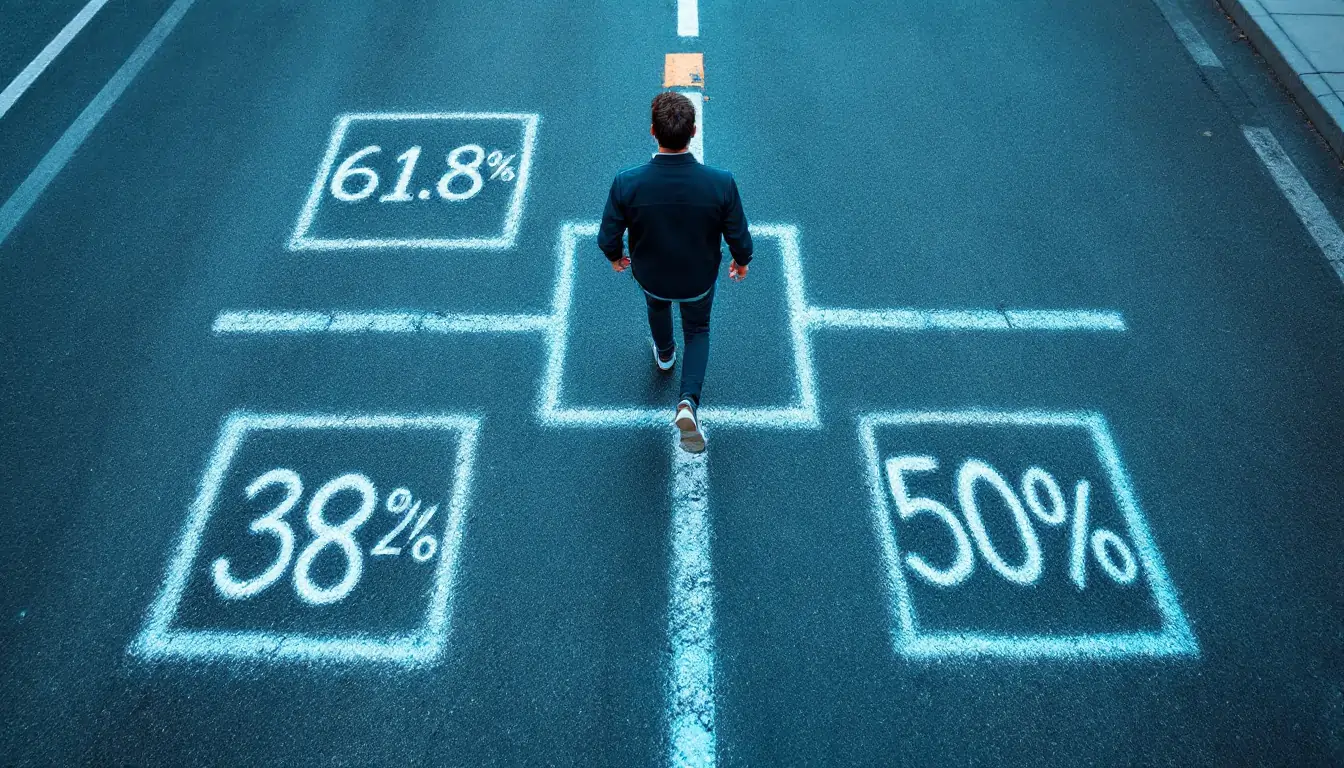
    • The 38.2% Level: A pullback to this level is shallow. It signals immense confidence among the bulls in an uptrend. The profit-taking was minimal, and new buyers were so eager to join the trend that they did not wait for a bigger discount. It projects an image of strength and urgency.
    • The 50% Level: This is not a formal Fibonacci number, but it is included in most tools because of its immense psychological weight. A 50% retracement means the market has given back exactly half of its prior gain.

      It represents perfect equilibrium. The battle between buyers and sellers is evenly matched. A bounce from here is significant because it shows the bulls have successfully defended the halfway point and wrestled back control.
    • The 61.8% Level: This is the line in the sand for many professional traders. It represents a substantial discount from the peak and a prime opportunity to enter if the trend is still valid. The psychology is complex. Traders who missed the initial move see it as their ideal entry.

      Those already in the trend feel the acute pain of watching over half their paper profits evaporate. A decisive hold of this level often triggers a wave of new buying, as it confirms the trend’s resilience.

    The Amplifier Effect of Algorithmic Trading

    In modern markets, this psychology is amplified by machines. Institutional trading is dominated by algorithms. These are computer programs designed to execute trades based on predefined rules. A significant portion of these algorithms are programmed to recognize and act on Fibonacci levels.

    When a major currency pair like the GBP/JPY starts to retrace toward its 61.8% level, it is not just human traders who notice. A multitude of institutional algorithms also identify this exact price. They are programmed to execute enormous buy orders at or near that level. This creates an invisible wall of demand.

    The moment the price touches the zone, these high-speed algorithms fire, absorbing the selling pressure and often causing a sharp reversal. The retail trader who placed a buy order at that level was correct, but their individual order was insignificant. The move was driven by the institutional weight of automated systems all acting on the same psychological principle, a principle first coded by a human.

    The Danger of Confirmation Bias

    A responsible, journalistic approach requires acknowledging the tool’s limitations. The most significant psychological trap for a trader using Fibonacci is confirmation bias. This is the tendency to search for, interpret, and recall information in a way that confirms one’s preexisting beliefs.

    A trader will vividly remember the one time they bought the 61.8% retracement perfectly and the market soared, creating a massive profit. They will conveniently forget the three other times the price sliced right through the level and stopped them out for a loss. The human brain is a pattern-recognition machine, and it can easily impose patterns where none exist.

    Looking at a historical chart, it is simple to find Fibonacci levels that appear to have worked perfectly. This retrospective fitting is deceptive and creates a false sense of the tool’s predictive power. A professional analyst actively fights this bias. They do not seek to prove the tool works; they seek to identify, with objectivity, the instances where it provides a statistical edge.

    Trading the Reaction, Not the Level

    Understanding the psychology behind Fibonacci levels transforms how a trader interacts with them. An amateur sees the 61.8% level and places a blind buy order, hoping it holds. A professional sees the 61.8% level as a “region of interest.” They do not trade the level itself. They trade the market’s reaction to the level.

    They watch as the price approaches this key psychological battleground. They observe the candlesticks. Do sellers appear to be running out of momentum? Do long wicks appear, indicating buyers are starting to push back? Do they see a strong, bullish engulfing candle form right at the level?

    This confirmation signal is the evidence they need. It is the market communicating that the psychological battle is over and the buyers have won.

    The entry is based not on a mathematical line, but on a confirmed shift in collective human behavior. This mindful approach removes the emotion of hope and replaces it with a strategy of observation and execution.

  • Break the Cycle of Revenge Trading

    Break the Cycle of Revenge Trading

    You took a significant loss. The market moved against you with unexpected speed. Your stop loss triggered.

    A large portion of your account equity vanished in minutes. The initial shock gives way to a hot, rising anger. You feel an intense pressure to act. To get it back. To open another position, bigger this time, and force the market to give you back what it took.

    This impulse is revenge trading. It is a deeply human reaction to financial pain. It is also one of the fastest ways to destroy a trading account. Controlling this impulse is not a minor aspect of trading. It is the central challenge that separates consistent traders from the crowd.

    This article gives you a direct, actionable framework to stop revenge trading. It will help you protect your capital and build the emotional discipline required for long-term success.

    Understanding the Psychology of a Loss

    To defeat an enemy, you first need to understand it. Revenge trading is an emotional enemy. It operates on primal instincts, not logic. When you suffer a large financial loss, your brain does not react rationally. It perceives the loss as a threat, triggering a fight-or-flight response. Adrenaline floods your system. Your heart rate increases.

    Your ability to perform complex analysis evaporates. You are not thinking like a trader. You are thinking like a cornered animal.

    Several cognitive biases fuel this dangerous state. The first is loss aversion. Behavioral economists proved that the psychological pain of losing is twice as powerful as the pleasure of gaining an equal amount. Your brain screams that you must erase the pain of the loss immediately.

    The fastest way to do that seems to be winning it back on the next trade. This creates a powerful urge to jump back into the market without a plan.

    The sunk cost fallacy also plays a role. You have already invested time, emotional energy, and capital into a trade that failed. Instead of cutting your losses and moving on, you feel committed. The mind incorrectly reasons that since you have already lost so much, you must continue in order to recover your investment. This faulty logic pushes you to double down on a bad situation.

    Ego is the final ingredient. A loss feels personal. It feels like the market is telling you that you are wrong. For many, this is unacceptable. The need to prove their analysis was correct overrides all risk management rules. The trade stops being about probabilities and starts being about personal vindication. You are no longer trading the market. You are fighting it. This is a fight you will not win. Recognizing these psychological triggers is the first step toward disarming them.

    Your First Response to a Major Loss

    What you do in the first 60 minutes after a significant loss determines your fate. Your impulses will tell you to stay glued to the screen, to look for a new entry point, to fix the problem immediately. You must do the exact opposite. Your immediate goal is not to fix the trade. Your immediate goal is to regain control of your mind.

    The first and most important action is to walk away. Stand up from your desk. Close your trading platform. Leave the room where you trade. The physical act of moving creates a mental separation. Go outside. Get fresh air.

    Do something that forces your mind onto a different track. The charts will be there tomorrow. Your capital will not be if you act on impulse.

    Next, you must completely disconnect. Do not check prices on your phone. Do not read financial news. Do not open trading forums or social media groups. Every piece of market information you consume will fuel the emotional fire. You need a total circuit break from the market. This period of disconnection allows your nervous system to calm down.

    The adrenaline will subside. Your rational mind will begin to re-engage.

    During this time, acknowledge the emotion. Do not suppress it. Name it. Are you angry? Say, “I am angry about that loss.” Are you frustrated? Say, “I am frustrated that my plan failed.” Acknowledging the feeling reduces its control over you. When you try to ignore or fight an emotion, you give it more power. When you observe it and name it, you put yourself back in a position of control. You see it for what it is: a chemical reaction, not a command to act.

    Building a Long-Term Defense System

    Preventing revenge trading is not about willpower at the moment. It is about building systems that make it difficult to misbehave. Your success depends on the work you do before you ever place a trade. A professional trader operates within a rigid framework. This framework is their primary defense against emotional decisions.

    Your trading plan is this framework. It must be written down. It must be specific. Most importantly, it must contain non-negotiable rules for risk. Your plan should explicitly state your maximum loss per day, per week, and per month.

    For example, you might decide that if you lose 2% of your account capital in a single day, you are done trading. You will close all platforms and not open them again until the next session. This is not a suggestion. It is a hard rule. When you hit that limit, the decision is already made for you. There is no room for in-the-moment negotiation with your emotional brain.

    A trading journal is your second critical tool. A journal is not just a log of your entries and exits. It is a log of your mental state. For every trade, you should record why you took it, what you were thinking, and how you felt. When you take a loss, this practice is essential. Write down exactly what happened. Describe your emotional reaction. Did you feel the urge to revenge trade? What did it feel like? This process forces you to become an objective observer of your own behavior.

    Over time, you can review your journal to find patterns. You will see when you are most vulnerable. Perhaps it is after a string of small wins, which leads to overconfidence. Perhaps it is on a specific day of the week. Or with a particular asset. This data allows you to anticipate your weaknesses. You can then build specific rules to protect yourself. For instance, if you find you always get emotional trading a certain instrument, you either avoid it or trade it with a smaller position size. Your journal turns your emotional reactions into data you can analyze and act upon.

    Re-engaging the Market with Discipline

    After taking a large loss and following a cool-down period, you cannot simply return to trading as usual. Your confidence is fragile. Your primary goal now is not to make back the money you lost. Your goal is to execute a series of clean, disciplined trades according to your plan. Rebuilding your confidence is a process that requires patience and precision.

    Begin by reducing your position size. Cut it in half, or even to a quarter of your normal size. Trading with smaller size lowers the emotional stakes. It allows you to focus purely on your process without the intense pressure of significant financial outcomes.

    Your objective for the next ten trades is simply to follow your rules perfectly. A winning trade where you broke your rules is a failure. A losing trade where you followed every rule perfectly is a success. You are retraining your brain to associate good outcomes with good process, not with random profits.

    Next, you must conduct a detailed post-mortem of the original losing trade. Was the loss a result of a mistake? Did you enter too early? Did you fail to respect your stop loss? If so, identify the specific error. Write down a rule in your trading plan to prevent that error in the future. Or was the trade a valid setup that simply did not work?

    In trading, you can do everything right and still lose. Accepting this fact is a huge step in a trader’s development. It separates the process from the outcome. When you understand that losses are a normal cost of doing business, they lose their emotional power.

    Only after you have executed a series of well-managed trades with a smaller size should you consider gradually increasing your position size back to its normal level. This methodical approach proves to you that you are in control. It rebuilds confidence on a foundation of discipline, not on the hope of a single winning trade. It is a deliberate, professional approach to returning from a setback.

    Mastering your emotions is the final frontier in trading. The market will always provide opportunities. Your ability to capitalize on them over the long run depends entirely on your ability to remain objective and disciplined, especially in the face of a loss. Revenge trading is a symptom of a lack of structure.

    By building a robust trading plan, meticulously journaling your actions, and focusing on process over profits, you build a fortress of discipline. You replace impulsive, emotional reactions with a calm, methodical process. This is how you survive. This is how you grow as a trader.

    Ready to start?

  • Is Fear of Missing Out (FOMO) Silently Wrecking Your Account?

    Is Fear of Missing Out (FOMO) Silently Wrecking Your Account?

    Fear of missing out, or FOMO, is a powerful force. It drives you to make impulsive decisions. In trading, these decisions are almost always expensive. You see a chart moving higher. You hear chatter on social media about a stock taking off. An urgent feeling builds. You feel you must get in on the action now, before the opportunity is gone forever. So you jump in. You buy without a plan. You chase the price. This is not a strategy. It is gambling. 

    FOMO hijacks your rational mind and puts your emotions in control. The result is often the same: a damaged trading account and a lesson learned too late. Developing emotional control is the most critical skill for a trader. It separates consistent performers from the crowd. This is not about finding the perfect indicator. It is about mastering yourself.

    Understanding Trading FOMO

    FOMO in trading is the fear that others are profiting from a market move, and you are not. This anxiety compels you to enter a trade without proper analysis or a clear strategy. It is rooted in a basic human desire to be part of a winning group. Modern technology amplifies this feeling. 

    You have constant access to financial news, social media, and trading forums. Every moment, you see others posting about their gains. This creates a distorted view of reality. You only see the wins, not the many losses. You start to believe everyone is succeeding except you.

    Disciplined trading is different. A disciplined trader operates from a plan. Every action has a reason. Entry and exit points are defined before the trade is placed. Risk is calculated and managed. The disciplined trader accepts that missing an opportunity is part of the business. 

    Another one will always come along. The FOMO-driven trader, in contrast, acts on impulse. They see a fast-moving market as a personal threat. Their decisions are reactive, not proactive. They are not trading their strategy. They are trading their emotions. This path leads to consistent losses.

    Anatomy of a FOMO Trade

    Consider this common scenario. You start your trading day with a clear plan. You have identified potential setups based on your research. Suddenly, a stock not on your watchlist begins to surge. Your social media feed lights up. 

    People are posting screenshots of their profits. News headlines flash across your screen. The pressure builds. Your carefully prepared plan feels irrelevant. The only thing that matters is getting into this trade.

    You abandon your rules. You buy at a price far from any logical entry point. For a moment, you feel relief. You are in the trade. You are part of the action. The price might even move a little higher, giving you a brief sense of validation. Then, the market turns. The initial excitement evaporates. It is replaced by anxiety. The price drops further.

    Now, you are in a losing position with no plan. You did not set a stop-loss because you never expected the trade to fail. Panic sets in. Do you sell and take the loss? Do you hold on, hoping it will recover? Your mind races. 

    You are paralyzed by indecision. Often, you hold on too long, and a small loss becomes a significant one. This single trade, born from impulse, inflicts serious damage on your account balance. It also erodes your confidence, making it harder to trade effectively in the future.

    Identify Your Personal Triggers

    To conquer FOMO, you first must understand what triggers it in you. The triggers are different for everyone, but some are common. Watching a live chart of a volatile asset for too long induces anxiety. 

    Scrolling through social media and seeing others celebrate their wins is a powerful catalyst. Breaking news stories designed to create urgency can easily push you into a bad decision. Even conversations with other traders can plant the seed of FOMO if they focus only on big wins.

    The most effective tool to identify your triggers is a trading journal. A journal is more than a record of your trades. It is a record of your state of mind.

    For every trade you take, write down why you entered.

    • What were you feeling?
    • Were you calm and following your plan?
    • Or were you anxious and chasing the market?
    • Note the external factors.
    • Were you reacting to a news alert?
    • Did you see something on a forum? 

    Over time, patterns will emerge. You will see a clear link between certain situations and your impulsive trades. This self-awareness is the first step toward taking control. Once you know what causes the reaction, you can build a defense against it.

    Build Your Defense Against FOMO

    You defeat FOMO with discipline and structure. Your emotions are unreliable in a trading environment. Your system must be robust enough to protect you from yourself. This requires building and following a set of non-negotiable rules.

    First, you need a trading plan. A trading plan is your constitution. It governs every decision you make. It must be written down. It must be specific. Your plan should detail the exact criteria for entering a trade. It should define your exit strategy, including both your take-profit target and your stop-loss level. 

    Most importantly, it must include risk management rules. A common rule is to risk no more than 1% of your account on a single trade. When you have a complete plan, there are no gray areas. Either a setup meets your criteria, or it does not. If it does not, you do not trade. There is no room for emotion.

    Second, you must cultivate patience. The market is not going anywhere. It will be open tomorrow, next week, and next year. Opportunities are infinite.

    The belief that one trade is your only chance for success is an illusion created by FOMO. A professional trader thinks in terms of probabilities over a long series of trades. They know some trades will lose. They know they will miss some winners. It does not matter. What matters is sticking to their plan consistently.

    When you feel the urge to chase a trade, step away from your screen. Remind yourself that no single trade will make or break your career. Your discipline will.

    Third, you must control your information intake. Constant exposure to market noise is a direct cause of FOMO. You do not need to watch every tick of the price. You do not need to read every news article or social media post. This is just noise. It clouds your judgment. 

    Define specific times during the day to check the markets and read financial news. Outside of these times, close your charts. Turn off notifications. Unfollow accounts that promote hype and unrealistic returns. Your goal is to create a calm and focused trading environment, free from external pressures.

    The Joy of Missing Out

    The mindset of a successful trader is different. They do not fear missing out. They embrace it. They understand that missing a chaotic, unpredictable market move is a victory. It means they followed their plan. It means they protected their capital.

    This is the Joy of Missing Out, or JOMO. JOMO is a sign of emotional maturity. It is the quiet confidence that comes from knowing you are in control of your actions, regardless of what the market is doing.

    Every time you feel the pull of FOMO and choose not to act, you strengthen your discipline. You are not just avoiding a potential loss. You are building a habit of rational decision-making. Over time, this becomes your default state. Chasing trades will feel unnatural. Sticking to your plan will feel correct. 

    The peace of mind that comes from this approach is a significant reward. You will sleep better. You will approach each trading day with calm and clarity. Your focus will shift from short-term excitement to long-term consistency. This is the foundation of a sustainable trading career.

    Mastering your emotions is the ultimate challenge for a trader. The market is an arena of psychology. FOMO is one of the most destructive forces you will face. It preys on your insecurities and pushes you to self-destruct.

    But you have the ability to fight back. You do this with a concrete plan, unwavering patience, and strict control over your environment. 

    Stop letting fear dictate your decisions. Start building the discipline that leads to consistent performance. The first step is to write down your trading plan. Define your rules. Commit to following them. Your future self will thank you for it.

    Test Your Self Control